

Think paid advertising is only for companies with massive budgets and dedicated marketing teams? That’s one of the biggest myths holding back small business owners in Southern California. In reality, paid advertising delivers fast, measurable results that can transform how local businesses generate leads and compete in crowded markets. Whether you run a boutique in Orange County or a service business in Los Angeles, understanding how paid ads work and when to use them can unlock immediate visibility and growth. This guide breaks down everything you need to know about paid advertising, from core pricing models to local targeting strategies that work specifically for Southern California SMBs.
Table of Contents
- Key takeaways
- What is paid advertising and how does it work?
- Key models and strategies in paid advertising
- The role of paid advertising in local Southern California markets
- Combining paid and organic marketing for sustainable growth
- Elevate your business with expert digital marketing support
- Frequently asked questions about paid advertising
Key Takeaways
| Point | Details |
|---|---|
| Fast measurable results | Paid ads deliver quick, trackable leads for local markets facing competition. |
| Pricing models | The main models are PPC CPM CPV and CPA, each serving different goals. |
| Auction based placement | Ad positions are won in auctions that weigh bid quality relevance and expected clicks. |
| Targeting and budgeting | Effective campaigns rely on precise geographic and demographic targeting plus careful budget management. |
| Paid and organic mix | Combining paid campaigns with organic strategies boosts long term ROI. |
What is paid advertising and how does it work?
Paid advertising is a marketing strategy where businesses pay to display ads to targeted audiences on digital platforms like Google, Facebook, Instagram, and YouTube. Unlike organic marketing that builds visibility gradually through content and SEO, paid advertising uses auction-based systems to place your message directly in front of potential customers right now.
Here’s how the fundamental mechanics work. When you create a paid ad campaign, you enter an auction where your ad competes with other businesses for placement. The platform evaluates several factors including your bid amount, ad quality, relevance to the search query or audience, and expected click-through rate. The highest quality, most relevant ads win the best positions, not necessarily the highest bidders. This levels the playing field for SMBs competing against larger companies.
For Southern California business owners, platforms like Google Ads and Facebook Ads offer powerful targeting options that make paid advertising particularly effective:
- Geographic targeting by city, zip code, or radius around your business location
- Demographic filters including age, gender, income level, and household composition
- Interest-based targeting that reaches people actively searching for your products or services
- Device targeting to optimize for mobile users in specific locations
- Time-of-day scheduling to show ads when your target customers are most active
The beauty of paid advertising for small businesses lies in its measurability. Every click, impression, and conversion gets tracked, giving you clear data on what works and what doesn’t. You can start with a modest budget, test different messages and audiences, then scale up the campaigns that deliver the best return. This makes paid ads an ideal tool for digital advertising strategies that need to generate leads quickly in competitive markets.
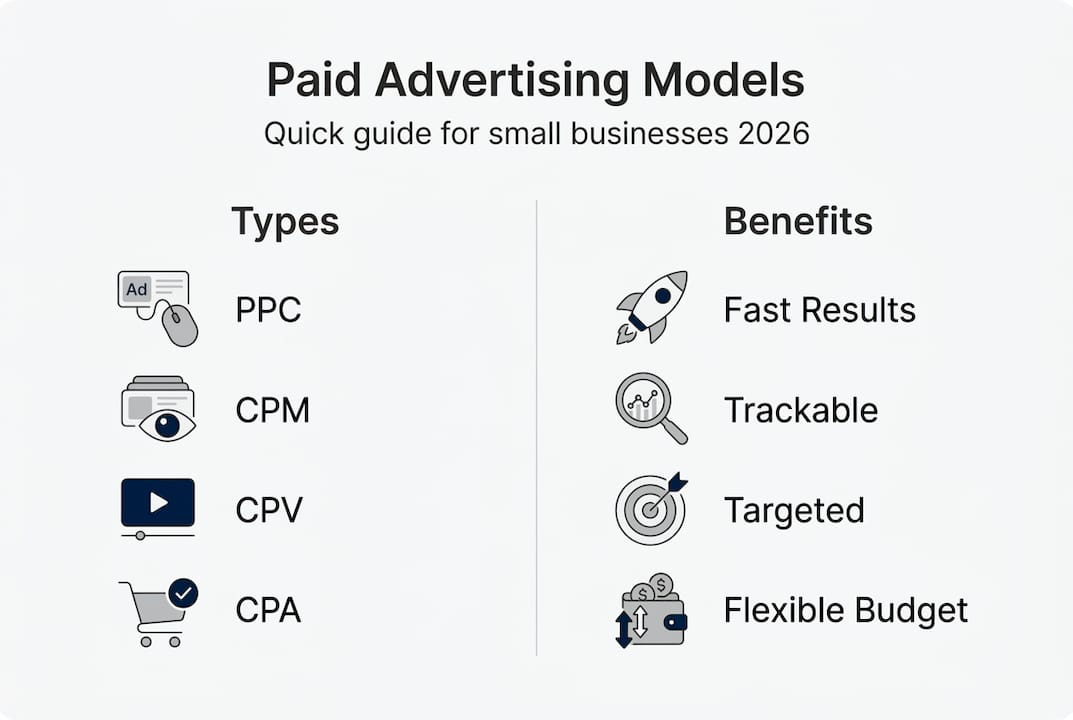
Unlike traditional advertising where you pay upfront without knowing results, digital paid advertising lets you set daily budgets, pause campaigns instantly, and adjust targeting in real time based on performance data. For a local retailer in Orange County or a service provider in Los Angeles, this means you can compete effectively without wasting money on audiences that won’t convert.
Key models and strategies in paid advertising
Understanding the core pricing models helps you choose the right approach for your business goals and budget. Four primary methodologies dominate paid advertising: pay-per-click (PPC), cost-per-thousand-impressions (CPM), cost-per-view (CPV), and cost-per-acquisition (CPA). Each serves different strategic purposes.
Pay-per-click (PPC) charges you only when someone clicks your ad. This model works exceptionally well for search advertising where you want to capture high-intent customers actively looking for your products or services. If you run a plumbing business in Los Angeles, PPC lets you appear at the top of Google when someone searches “emergency plumber near me.” You pay nothing for impressions, only for actual clicks that bring potential customers to your website or phone number.
Cost-per-thousand-impressions (CPM) charges based on how many times your ad displays, regardless of clicks. This model suits brand awareness campaigns where you want maximum visibility. A new restaurant in Orange County might use CPM on Facebook to ensure thousands of local residents see their grand opening announcement, building recognition even if they don’t click immediately.
Cost-per-view (CPV) applies to video advertising platforms like YouTube. You pay when someone watches your video ad for a specified duration or interacts with it. This works well for businesses that can demonstrate their value visually, like home remodeling contractors showing before-and-after transformations.
Cost-per-acquisition (CPA) charges only when someone completes a desired action like making a purchase, filling out a contact form, or calling your business. This performance-based model offers the lowest risk since you pay only for actual conversions, but typically requires higher per-action costs.
| Pricing Model | Best For | Typical Cost Range | Risk Level |
|---|---|---|---|
| PPC | High-intent searches, lead generation | $1-$10 per click (varies by industry) | Medium (pay per click, not conversion) |
| CPM | Brand awareness, local visibility | $5-$15 per 1,000 impressions | Higher (pay for views, not engagement) |
| CPV | Video content, product demonstrations | $0.10-$0.30 per view | Medium (pay for views, not conversions) |
| CPA | Direct sales, lead capture | $20-$150 per acquisition | Lower (pay only for results) |
The auction system that determines ad placement considers more than just your bid. Quality score plays a crucial role in PPC advertising success. Platforms evaluate your ad relevance, landing page experience, and expected click-through rate. A highly relevant, well-designed ad with a great landing page can win better positions at lower costs than a poorly optimized ad with a higher bid.
Pro Tip: Monitor your quality score religiously. Improving ad relevance and landing page experience can cut your cost-per-click by 30-50% while improving your ad position. Focus on matching ad copy precisely to search intent and ensuring your landing page delivers exactly what the ad promises.
Strategic timing matters too. Use PPC when you need immediate lead generation and can track conversions clearly. Deploy CPM campaigns when launching new products or entering new markets where awareness matters more than instant sales. Reserve CPA for mature campaigns where you’ve optimized your conversion funnel and know your customer acquisition costs. Many successful SMBs in Southern California use a multi-channel digital marketing approach that combines these models based on specific campaign objectives.
The role of paid advertising in local Southern California markets
Southern California presents unique opportunities and challenges for small business owners. The region’s dense population, diverse demographics, and intense competition make paid advertising not just useful but often essential for survival and growth. Paid ads provide fast reach and measurability that organic marketing simply cannot match when you need results quickly.

Consider the competitive landscape. A coffee shop in Orange County competes not only with other independent cafes but also with major chains, each fighting for the same local customers. Organic social media posts and SEO improvements take months to build traction. Paid advertising puts you in front of potential customers today, capturing market share while you build your organic presence.
Local targeting features make paid advertising particularly powerful for Southern California SMBs:
- Radius targeting around your physical location to reach customers within driving distance
- Zip code targeting to focus on high-value neighborhoods or areas with your ideal customer demographics
- City-specific campaigns that account for the distinct characteristics of Los Angeles versus Orange County versus San Diego markets
- Mobile-first strategies that capture customers searching on smartphones while they’re out and about
- Time-based targeting to show ads during peak shopping or service hours in your specific market
The speed advantage cannot be overstated. A new dental practice in Los Angeles can start generating appointment bookings within days of launching a Google Ads campaign. A boutique retailer in Orange County can drive foot traffic this weekend with a Facebook ad promoting a flash sale. This immediacy makes paid advertising ideal for businesses that need cash flow now, not six months from now.
Industries that particularly benefit from paid advertising in Southern California include retail stores competing with e-commerce, service businesses like plumbers and electricians responding to urgent needs, restaurants and hospitality businesses promoting events or specials, and professional services like attorneys and accountants targeting specific client types. Each can use precise targeting to reach exactly the customers most likely to convert.
The measurability of paid advertising also matters enormously in competitive markets. You can track exactly which ads, keywords, and audiences generate the most revenue. A home services company can discover that ads targeting homeowners aged 45-65 in specific Orange County zip codes deliver three times the ROI of broader campaigns. This data-driven approach lets you optimize continuously, improving your local marketing effectiveness in ways that traditional advertising never could.
While paid advertising delivers fast results, the smartest Southern California SMBs recognize it works best as part of a comprehensive strategy. Paid ads get you immediate visibility and leads. Organic marketing builds the long-term credibility and trust that sustain your business. The combination creates a powerful growth engine that addresses both immediate needs and future sustainability.
Combining paid and organic marketing for sustainable growth
The most successful small businesses in Southern California don’t choose between paid advertising and organic marketing. They strategically combine both to maximize return on investment and build sustainable growth. Using ads for immediate boosts while developing organic channels for long-term trust creates a hybrid approach that delivers the best of both worlds.
Paid advertising provides immediate traffic and quick feedback. You can test new product offerings, messaging angles, and target audiences within days. Organic marketing through SEO, content creation, and social media builds credibility slowly but creates compounding returns over time. A blog post that ranks on Google continues driving traffic for years without ongoing ad spend. Social media followers become a owned audience you can reach without paying for each impression.
The strategic integration works like this. Use paid campaigns to drive initial traffic while your organic channels mature. A new business might allocate 70% of their marketing budget to paid ads in months one through six, then gradually shift to 40% paid and 60% organic as their SEO rankings improve and social following grows. The paid ads provide immediate revenue that funds the organic marketing investments.
Here’s a practical framework for balancing paid and organic efforts:
- Start with paid advertising to generate immediate leads and revenue while building brand awareness in your local market.
- Invest a portion of paid advertising profits into SEO optimization and content creation that will drive organic traffic over time.
- Use data from paid campaigns to identify your most profitable keywords, audiences, and messages, then optimize organic content around these insights.
- Develop social media presence organically while using paid social ads to accelerate follower growth and engagement.
- Create retargeting campaigns that use paid ads to re-engage visitors who found you organically but didn’t convert initially.
- Monitor the customer lifetime value from each channel and adjust budget allocation based on long-term profitability, not just immediate returns.
Pro Tip: Use paid campaigns as a testing laboratory for your organic marketing. Run multiple ad variations to discover which headlines, offers, and calls-to-action generate the highest conversion rates. Then apply these winning formulas to your organic content, email marketing, and website copy. This approach lets you optimize messaging quickly without waiting months for organic test results.
The hybrid strategy also provides insurance against platform changes. Businesses that rely solely on organic social media suffered when Facebook and Instagram dramatically reduced organic reach. Companies dependent only on paid ads face rising costs as competition intensifies. Diversification across paid and organic channels creates resilience and sustainable growth.
For Southern California SMBs, this balanced approach means you can compete with larger competitors who have bigger budgets. Your paid ads capture immediate market share while your organic presence builds the authority and trust that eventually reduce your dependence on paid advertising. Over time, the combination delivers lower customer acquisition costs and higher lifetime value than either channel alone.
Elevate your business with expert digital marketing support
Navigating the complexities of paid advertising platforms, auction systems, and targeting options can overwhelm small business owners already juggling daily operations. Professional digital marketing consulting tailored specifically for Southern California markets can optimize your campaigns for better ROI while freeing your time to focus on running your business. Expert agencies understand the local competitive landscape, know which platforms and strategies work best for different industries, and can quickly identify opportunities that inexperienced advertisers miss.
Working with specialists who combine PPC advertising expertise with deep knowledge of Southern California demographics and market conditions gives you a competitive edge. They can set up proper conversion tracking, manage bid strategies, optimize ad creative, and continuously refine targeting to reduce wasted spend. The right partner doesn’t just run your ads but integrates paid advertising into a comprehensive digital marketing strategy that aligns with your business goals and budget constraints. For SMBs serious about growth, professional support often pays for itself through improved campaign performance and time savings that let you focus on delivering great products and services.
Frequently asked questions about paid advertising
What platforms are best for local SMB paid ads?
Google Ads works exceptionally well for service businesses and retailers because it captures high-intent customers actively searching for solutions. Facebook and Instagram excel for businesses with strong visual appeal targeting specific demographics in local areas. Most Southern California SMBs see best results using Google for search intent and Facebook for awareness and retargeting.
How much should small businesses budget for paid advertising?
Start with $500-$1,000 monthly to test campaigns and gather meaningful data, then scale based on results. Most successful SMBs allocate 5-10% of revenue to total marketing, with 40-60% of that going to paid advertising initially. The key is starting small, measuring ROI carefully, and increasing spend only on campaigns that prove profitable.
Can paid ads work without organic marketing?
Paid ads can generate leads and sales independently, but combining them with organic marketing significantly improves long-term ROI and sustainability. Customers who see your paid ads and then find positive organic content, reviews, and social proof convert at much higher rates. Pure paid advertising also becomes expensive over time as you must continuously pay for every customer, while organic channels create compounding returns.
How quickly can SMBs see results from paid ads?
Most businesses see initial traffic and leads within 24-48 hours of launching campaigns. However, optimizing for profitable results typically takes 2-4 weeks as you gather data, test variations, and refine targeting. Service businesses often see qualified leads within the first week, while e-commerce may need longer to optimize product ads and audiences for positive ROI.
What are common mistakes to avoid in paid advertising?
The biggest mistakes include targeting too broadly instead of focusing on your ideal local customers, sending traffic to poor landing pages that don’t convert, failing to track conversions properly so you can’t measure ROI, setting budgets too low to gather meaningful data, and giving up too quickly before optimization improves results. Start with narrow geographic and demographic targeting, ensure your landing pages load fast and match ad promises, and commit to at least 30 days of testing before evaluating success.


