

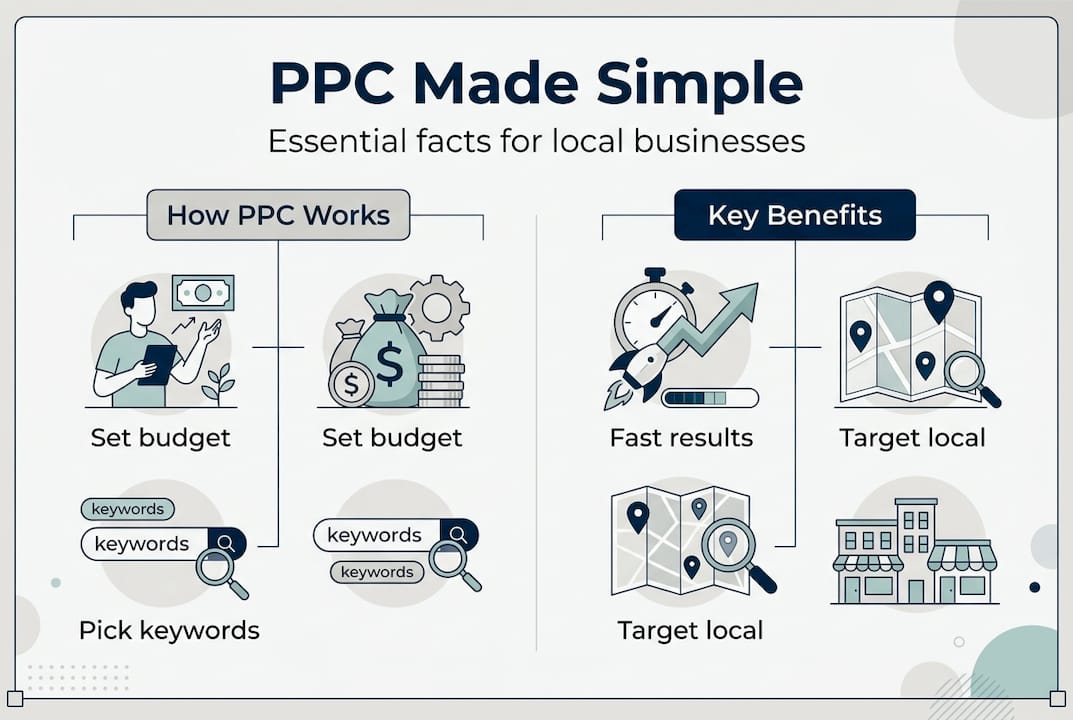
Most local business owners assume digital ads work like a billboard: you pay to be seen, whether anyone notices or not. PPC advertising flips that model entirely. PPC stands for pay-per-click, meaning you only pay when someone actually clicks your ad. Not when it appears. Not when someone scrolls past it. Only when they engage. PPC runs across platforms like Google Ads, Microsoft Ads, Facebook, and Instagram, all powered by keyword auctions that decide which ads show up and when. This guide will walk you through exactly how PPC works, what makes it affordable, and how Southern California business owners can use it to drive real results.
Table of Contents
- How PPC advertising works
- Why Quality Score matters in PPC
- Common PPC pitfalls and expert strategies
- Practical steps to launch PPC for your local business
- Discover local PPC solutions and digital marketing support
- Frequently asked questions
Key Takeaways
| Point | Details |
|---|---|
| PPC pays only for clicks | Pay-per-click advertising charges you only when someone clicks your ads, not for views. |
| Quality Score is crucial | Improving your Quality Score reduces costs and gets your ad seen more easily. |
| Avoid common PPC mistakes | Use negative keywords, check AI suggestions, and test new ad creatives to maximize results. |
| Step-by-step process works | Launching PPC is straightforward when you follow a clear sequence from platform selection to ongoing optimization. |
| Local support available | Specialized PPC and digital marketing help is available for Southern California businesses. |
How PPC advertising works
PPC is straightforward once you see the mechanics behind it. You create an ad, choose the keywords you want to trigger it, set a maximum bid, and your ad competes in a real-time auction every time someone searches. The platform decides which ads to show based on your bid and your ad’s relevance. You only get charged when someone clicks.
Here’s where your ads can appear:
- Search results pages on Google or Bing, right above the organic listings
- Display banners on websites across the internet through Google’s Display Network
- Social media feeds on Facebook, Instagram, and LinkedIn
- YouTube pre-roll ads before videos your audience is already watching
- Google Maps listings for local searches like “plumber near me”
Understanding paid advertising basics helps you choose the right platform for your goals. Google Ads is best for capturing people who are already searching for what you offer. Social platforms like Facebook and Instagram are better for building awareness with a targeted local audience.
Here’s a quick comparison to help you decide where to start:
| Feature | Search ads | Display ads |
|---|---|---|
| Trigger | User keyword search | Browsing behavior or interests |
| Intent level | High (ready to buy) | Lower (awareness stage) |
| Format | Text only | Image, banner, video |
| Best for | Leads and calls | Brand awareness |
| Typical CPC | Higher | Lower |
The digital advertising steps for setting up your first campaign are more manageable than most people expect. The key is starting with one platform, one goal, and one audience before expanding.
Why Quality Score matters in PPC
Understanding how your ads are shown is one part of the puzzle. The real secret to affordable, effective PPC is optimizing your Quality Score. This is a number Google assigns to each of your keywords on a scale of 1 to 10. A higher score means lower costs and better placement, even if a competitor is outbidding you.
Quality Score rates three things: your expected click-through rate (CTR), how relevant your ad is to the keyword, and the experience someone has when they land on your page. All three factors work together. A weak landing page can drag down an otherwise strong ad.
Here’s how Quality Score affects your real-world results:
| Quality Score | Estimated CPC impact | Ad position effect |
|---|---|---|
| 1 to 3 | Up to 400% above base CPC | Poor placement, low visibility |
| 4 to 6 | Near base CPC | Average position |
| 7 to 9 | Up to 50% below base CPC | Strong placement |
| 10 | Maximum discount | Top placement |
This is why a small local business with a tight budget can outperform a larger competitor. If your ad is more relevant and your landing page is better, Google rewards you with lower costs and higher visibility. AI optimization tools can help you identify where your Quality Score is losing points and fix those gaps faster.
Pro Tip: Don’t obsess over your bid amount. A landing page that directly matches your ad’s promise will do more for your Quality Score than raising your bid by 20%. Make sure the page someone lands on answers exactly what your ad offered.
Using AI tools for marketing can also help you analyze which keywords are dragging your score down so you can pause or refine them before they waste your budget.
Common PPC pitfalls and expert strategies
Even with a solid Quality Score, many business owners trip over hidden PPC mistakes. Here’s how to avoid them and keep your ad spend working efficiently.
The most common mistakes local businesses make include:
- Skipping negative keywords: If you offer paid services, add “free” as a negative keyword so you don’t pay for clicks from people who will never buy
- Ignoring retargeting: Someone who visited your site and left is far more likely to convert than a cold visitor. Retargeting ads bring them back
- Oversegmenting campaigns: Breaking your campaigns into too many tiny groups can confuse the algorithm and reduce performance
- Sending traffic to a weak landing page: Your homepage is rarely the right destination. Build a page that matches the ad’s specific promise
- Over-relying on AI without checking results: Automation is powerful, but PPC mistakes in ad accounts often come from letting AI run unchecked without reviewing actual targeting data
Another common trap is chasing the top ad position. That metric was retired, and PPC myths heading into 2026 confirm that position one does not always mean the best return. A lower position with a higher Quality Score and better ad copy often outperforms the top spot.
“Quality Score drops from low relevance. Don’t rely on bid alone to fix a relevance problem.”
Looking at social media campaign examples from real businesses shows how creative testing makes a measurable difference. Swap out your headline, change your call to action, or test a different image. Small changes can shift your click-through rate significantly. A lawyer marketing case study from our own work shows how refining ad copy and landing pages together drove a dramatic improvement in lead quality.
Pro Tip: Set a reminder to review your ad creative every 30 days. Ads get stale fast, and fresh copy keeps your click-through rate healthy, which directly supports your Quality Score.
Practical steps to launch PPC for your local business
Armed with expert strategies and an understanding of PPC’s underlying mechanics, you’re ready to dive in. Here’s exactly how local businesses can launch PPC step by step.
- Choose your platform. Start with Google Ads if your customers are actively searching for your service. Use Facebook or Instagram if you want to build local awareness with a specific demographic.
- Set a clear goal. Decide what a successful click looks like. Is it a phone call, a booking form submission, or a visit to your location? Your goal shapes every other decision.
- Research your keywords. Use Google’s Keyword Planner to find terms your local customers actually search. Include location-specific phrases like “HVAC repair Pasadena” or “dentist near Long Beach.”
- Build your negative keyword list. Before you launch, add terms that would attract the wrong audience. This protects your budget from day one.
- Write focused ad copy. Your headline should match the keyword. Your description should state the benefit and include a clear call to action. Keep it direct and specific.
- Build or refine your landing page. The page must deliver exactly what the ad promised. Include your phone number, a simple form, and a reason to act now.
- Set your budget and launch. Start conservatively. Even $10 to $20 per day gives you enough data to learn from within the first two weeks.
- Monitor and adjust. Check your campaign every few days. Look at which keywords are converting and which are draining budget without results. AI automates bid management well, but it needs clean data and clear signals to work properly. Don’t set it and forget it.
For a broader view of how PPC fits into your overall strategy, mastering digital marketing as a system gives you the context to make smarter decisions at every stage.
Discover local PPC solutions and digital marketing support
You’ve learned how PPC works, what drives costs up or down, and how to avoid the mistakes that burn through budgets. If you’re ready to put this into practice but want experienced support behind you, Virality Creative works specifically with Southern California businesses like yours. Our local PPC management service handles everything from keyword research to campaign optimization, so you get results without the guesswork. We also offer digital marketing services that integrate PPC with SEO, social media, and content for a complete growth strategy. And if you want to see how automation can work for you, explore our AI tools for SMBs to get smarter about every dollar you spend.
Frequently asked questions
Do I need a big budget to start PPC advertising?
No. Google Ads lets you set daily and monthly spending limits, so you can start with as little as $10 a day and scale up only when you see results.
How long does it take to see PPC advertising results?
Most businesses see traffic within the first few days of launching. Optimizing for quality leads typically takes two to four weeks as your Quality Score stabilizes and you refine your targeting.
How can I make sure my PPC ads reach local customers?
Use location targeting in your campaign settings and include city or neighborhood names in your keywords and ad copy. Avoiding irrelevant traffic with negative keywords also keeps your budget focused on the right local audience.
Can AI help optimize my PPC campaigns?
Yes, AI can handle bid adjustments and audience targeting automatically. But as AI in PPC experts note, the quality of your results depends on the quality of the data and signals you feed into the system.


