

TL;DR:
- A structured social media plan is crucial for local businesses to gain engagement and growth.
- Focus on one or two platforms where your audience is active, with clear goals and consistent content.
- Regularly measure KPIs and adapt strategy to improve results and connect authentically with customers.
You spend an hour crafting the perfect post, hit publish, and then… nothing. No comments, no shares, barely any likes. Sound familiar? Most local business owners in Southern California are putting real effort into social media but getting frustratingly little back. The problem usually isn’t the content itself. It’s the lack of a structured plan behind it. With the right framework, social media stops feeling like a chore and starts working as a genuine growth engine. This guide walks you through exactly how to assess where you stand, set goals that matter, pick the right platforms, build a posting calendar, and measure what’s actually working.
Table of Contents
- Assess your social media starting point
- Define clear goals and your target audience
- Choose the right platforms and content mix
- Build and execute your monthly social media calendar
- Track results and adjust your strategy
- What most social media guides get wrong (and how you can win)
- Level up your social strategy with expert help
- Frequently asked questions
Key Takeaways
| Point | Details |
|---|---|
| Perform regular audits | Check your current social profiles for branding strength and engagement to set a baseline for growth. |
| Set actionable goals | Define specific objectives and your target audience so every post serves your business needs. |
| Streamline content planning | Choose the best platforms, batch content, and schedule posts to maximize consistency and save time. |
| Measure and adapt | Track key metrics monthly to refine your strategy and boost long-term results. |
| Local authenticity trumps perfection | Focus on connecting authentically with your neighborhood rather than trying to match big-brand output. |
Assess your social media starting point
Before you post another thing, you need an honest look at what you’re already working with. Think of it like checking your inventory before restocking. There’s no point doubling down on a platform that isn’t serving you, or ignoring one where your best customers are already hanging out.
Start by pulling these core metrics for each platform you’re active on:
- Followers: Total count and growth trend over the last 90 days
- Post frequency: How often you’re actually publishing
- Engagement rate: (Likes + comments + shares) divided by total followers, multiplied by 100
- Top performing posts: Which content got the most interaction
- Platform fit: Does the platform’s user base match your customer profile
Here’s a simple audit table you can fill out right now:
| Platform | Followers | Posts/week | Avg. engagement rate | Best content type |
|---|---|---|---|---|
| TikTok | ||||
Once you fill this in, patterns become obvious fast. You might notice Instagram gets 3x the engagement of Facebook with half the posts. That’s a signal worth acting on. Audit your social media profiles for branding consistency and engagement gaps before building anything new.
When reviewing your audit, flag these strengths and weaknesses:
- Strengths: Platforms with growing followers, consistent posting history, content types that regularly perform well
- Weaknesses: Platforms with stale bios, inconsistent branding, or posts that get zero interaction
For Southern California social media tips tailored to local markets, local context matters more than generic best practices. And if you want to build efficiency from the start, look into optimizing your social media workflow before you scale.
Pro Tip: Focus your early efforts on one or two platforms where your audience is already active. Spreading yourself across five platforms with mediocre content beats nothing, but owning two platforms with great content wins every time.
Define clear goals and your target audience
With your starting point documented, it’s time to pinpoint what you want to accomplish and who you’re trying to reach.
Here’s a truth most business owners skip past: setting clear, actionable goals is the single biggest predictor of social media success. Without a goal, every post is just a guess.
Common social media goals for local businesses include:
- Brand awareness: Getting more people in your area to recognize your name
- Store visits: Driving foot traffic through location-based promotions
- Lead generation: Collecting phone numbers, emails, or form submissions
- Online sales: Converting followers into paying customers through direct links
- Community building: Creating loyal repeat customers who refer others
Once you pick one or two primary goals, defining your audience becomes much more focused. Follow these steps:
- Identify demographics: Age range, gender, income level, and neighborhood or city within Southern California
- Map interests: What do your best current customers care about beyond your product or service
- Note location signals: Are they searching locally, attending community events, or following area influencers
- Analyze buying behavior: Do they research online before visiting in person, or do they impulse-buy based on a post
- Check platform habits: Where do they spend time online and at what hours
Knowing your audience directly shapes your content. A 35-year-old homeowner in Pasadena looking for a plumber responds to very different content than a 24-year-old in Long Beach looking for a new brunch spot. For deeper context on how this connects to digital marketing for local growth, the principles are the same across industries. Also consider how your branding for SoCal SMBs reinforces the message your audience expects to see.
Choose the right platforms and content mix
Now that you know your goals and audience, channel selection and content creation become much more strategic.

Each platform serves different content types and audience demographics. Choosing wrong wastes time and budget. Here’s a practical comparison:
| Platform | Best for | Content strengths | Weaknesses for local SMBs |
|---|---|---|---|
| Community, events, older demographics | Groups, ads, long posts | Organic reach has declined sharply | |
| Visual products, lifestyle, under-45 audience | Reels, Stories, carousels | Requires strong visual assets | |
| TikTok | Younger audiences, viral potential | Short video, trends | Time-intensive to produce |
| B2B services, professional credibility | Articles, thought leadership | Low purchase intent for consumer brands |
For most local Southern California businesses, Instagram and Facebook are the starting point. TikTok is worth testing if your audience skews younger or if you have video production capacity.
Content types that consistently build engagement for local businesses include:
- Behind-the-scenes videos showing your team or process
- Customer testimonials and before-and-after results
- Product sneak peeks or limited-time offer announcements
- Local event coverage or community involvement posts
- Educational tips relevant to your industry
For inspiration, check out real social media campaign examples from businesses that have made this work. And if you want to reduce the time burden, streamlining your content planning through batching and templates is a game changer.
Pro Tip: Repurpose content across platforms to save time. A 60-second video you shoot for TikTok can become an Instagram Reel, a Facebook post, and a still-frame graphic. One shoot, four assets.
Build and execute your monthly social media calendar
You know which channels to use. Here’s how to build a system for showing up consistently.
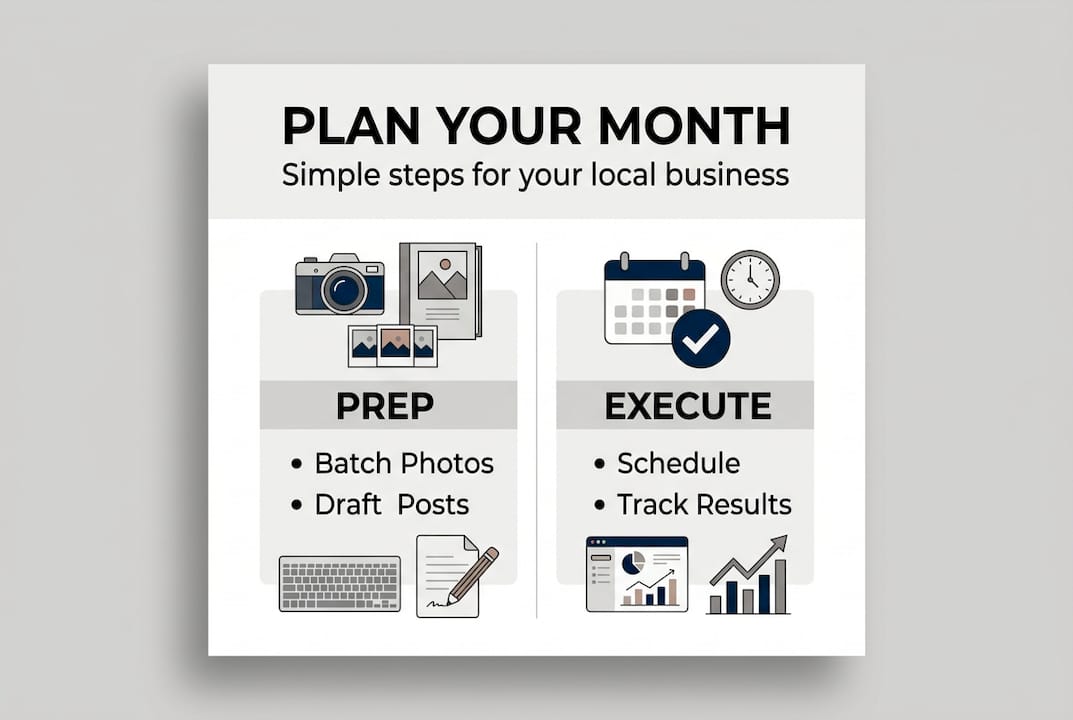
Consistency drives higher engagement on social media, and a calendar is the tool that makes consistency possible without burning out. Here’s a four-week framework:
- Week 1, brainstorm: List 12 to 16 post ideas based on your goals, upcoming promotions, local events, and seasonal moments
- Week 1, assign slots: Map each idea to a specific date and platform, aiming for two to three posts per week per channel
- Week 2, batch create: Write captions, design graphics, and film videos in one or two focused sessions rather than daily scrambles
- Week 2 to 3, schedule: Use a scheduling tool to queue everything up in advance
- Every week, community time: Block 20 to 30 minutes daily to respond to comments, answer DMs, and engage with local accounts
Useful tools to simplify this process:
- Meta Business Suite: Free scheduling for Facebook and Instagram
- Later or Buffer: Visual calendar planning with analytics
- Canva: Fast graphic creation with brand templates
- Google Sheets: Simple editorial calendar tracking
For more on streamlining your posting workflow and reducing manual effort, the right system saves hours every month. You can also apply broader digital marketing process tips to keep your whole strategy aligned.
Pro Tip: Batch produce all your visual assets at the start of each month. Set aside two hours, create everything at once, and you’ll never scramble for a last-minute graphic again.
Track results and adjust your strategy
After your first calendar, measuring success ensures your plan gets smarter each month.
Monitoring KPIs like engagement and click-through rate helps you stop guessing and start making data-driven decisions. Here are the key metrics to watch:
- Engagement rate: Likes, comments, and shares relative to reach
- Follower growth: Net new followers per month
- Link clicks: Traffic sent from social to your website or booking page
- Direct messages: Inbound inquiries generated from posts
- Reach and impressions: How many unique accounts saw your content
Use this sample monthly tracker to stay organized:
| Metric | Week 1 | Week 2 | Week 3 | Week 4 | Monthly total |
|---|---|---|---|---|---|
| Total posts published | |||||
| Avg. engagement rate | |||||
| New followers | |||||
| Link clicks | |||||
| DMs received |
“The businesses that win on social media aren’t the ones with the biggest budgets. They’re the ones who pay attention, adjust quickly, and keep showing up.”
After each month, ask yourself which content format performed best, which day and time got the most engagement, and whether your goal metrics moved in the right direction. Then test one variable at a time: try posting at a different hour, swap a static image for a video, or change your caption style. For more on how digital advertising for small businesses connects to your social strategy, the tracking principles overlap significantly.
What most social media guides get wrong (and how you can win)
Here’s what most guides won’t tell you: the formula they’re selling you was built for brands with full-time marketing teams, not a local business owner juggling ten other responsibilities.
We see this constantly with Southern California SMBs. They follow the “post every day, use these hashtags, optimize your bio” checklist and still get nowhere. Why? Because execution without experimentation is just busywork. The businesses that actually grow on social are the ones willing to try something, see what happens, and adjust without overthinking it.
Authenticity also outperforms polish more often than people expect. A shaky phone video of your team celebrating a milestone will almost always outperform a perfectly designed graphic with zero personality. Your customers want to connect with a real business, not a brand that looks like every other account in their feed.
For pro social media management insights that go beyond surface-level tips, the real edge comes from showing up as yourself, testing consistently, and caring more about your audience’s response than your aesthetic. Start simple. Refine as you go. That’s the actual playbook.
Level up your social strategy with expert help
If you want to accelerate success with less trial and error, the right support is close by. Working with a local team that understands the Southern California market means your strategy is built on real regional insight, not generic templates. Our social media management services are designed specifically for local businesses that want consistent results without the guesswork. Whether you need a full content strategy or help optimizing your social workflow for efficiency, we handle the heavy lifting. Explore marketing consulting for SMBs to find the right fit for your goals and budget, and start growing with a plan that actually works.
Frequently asked questions
How far in advance should I plan social media for my business?
Most businesses see the best results by planning content at least one month ahead while leaving room for trending or real-time posts. Consistent advance planning reduces last-minute stress and keeps your messaging aligned with your goals.
What’s the easiest way to track social media success?
Use a simple monthly spreadsheet to track engagement, follower growth, and post performance, then look for patterns each month. Monitoring KPIs regularly helps you identify what’s working before you invest more time or money into it.
Does my business need to be on every social platform?
No. It’s far better to focus on one or two channels where your customers are most active and deliver quality content consistently. Each platform serves different audiences, so choosing the right fit matters more than being everywhere at once.
How often should a local business post on social media?
Aim for at least two to three posts per week per platform, but always prioritize quality over volume. Consistency matters more than frequency, and a well-crafted post twice a week outperforms daily filler content every time.


