

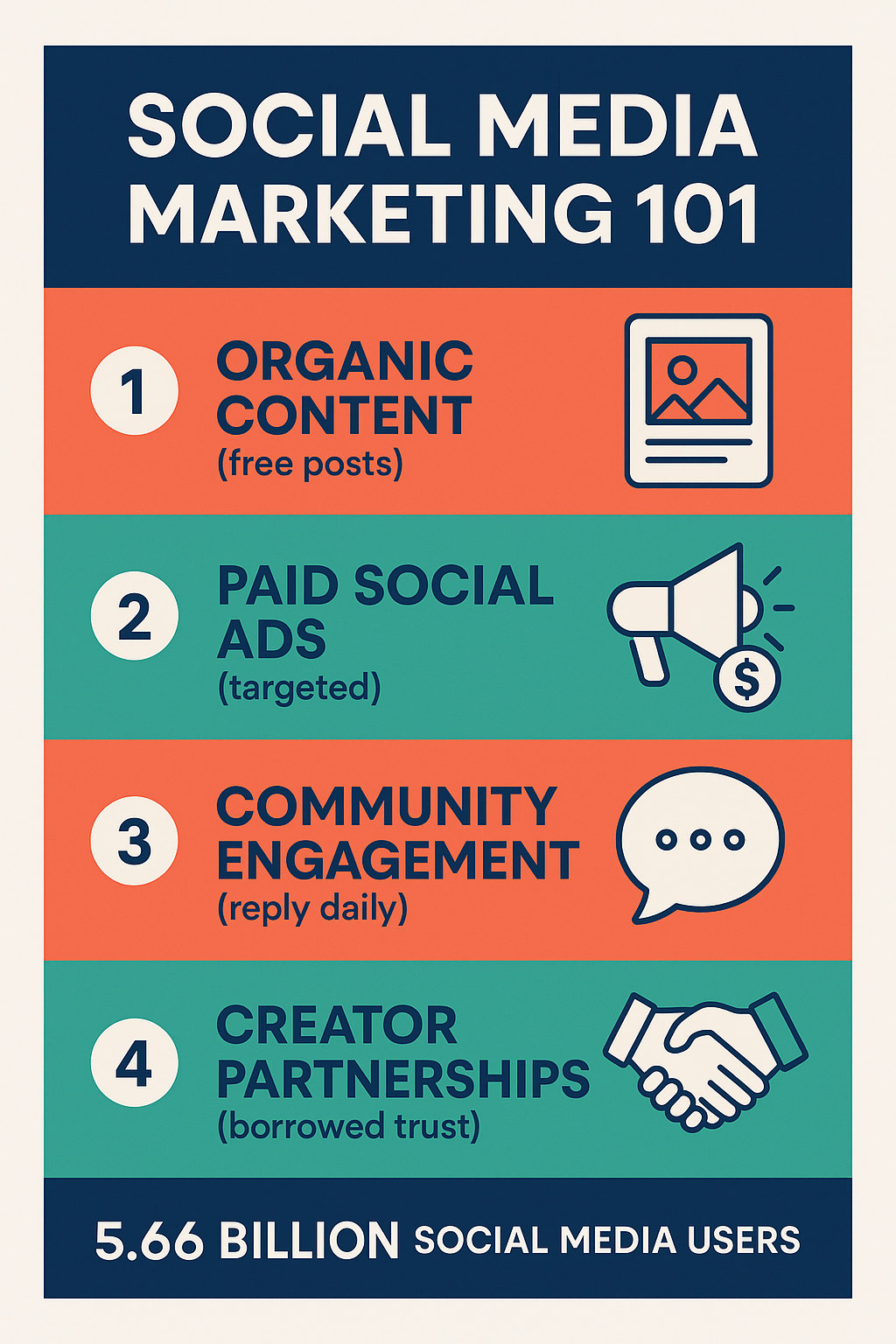
TL;DR: Social media marketing is using social platforms like Instagram, TikTok, Facebook, LinkedIn, and YouTube to reach customers, build an audience, and drive sales through a mix of organic content, paid ads, community engagement, and influencer partnerships. It works because attention lives there: Kepios data published by DataReportal puts global social media user identities at 5.66 billion, or 68.7% of the world’s population. Done well, it is a measurable growth channel. Done casually, it is just posting.
Table of contents
- What is social media marketing?
- Why social media marketing matters
- Types and channels of social media marketing
- Examples of social media marketing that worked
- Advantages and disadvantages
- How to create a social media marketing strategy in 7 steps
- Key takeaways
- People also ask
What is social media marketing?
Social media marketing is the practice of using social platforms to attract attention, build relationships, and convert that attention into customers. It covers four activities: publishing organic content, running paid social ads, engaging with your community in comments and DMs, and partnering with creators or influencers.
The simplest way to think about it: your website is where people buy, and social is where people find out you exist and decide whether they trust you. Using social media as marketing means every post has a job, whether that job is reach, proof, education, or a direct sale.
Academic work backs the framing. In the Journal of the Academy of Marketing Science, researchers Gil Appel, Lauren Grewal, Rhea Hadi, and Andrew T. Stephen describe social media moving toward an “omni-social” presence, meaning social influence now touches nearly every consumer decision rather than sitting in one isolated channel.
That is the shift most business owners miss. Social is not a separate marketing silo anymore. It feeds search, reviews, referrals, and even AI assistants that summarize what people say about your brand.
Why social media marketing matters
It matters because that is where your customers already spend their attention, and because the targeting is cheaper and more precise than almost any traditional channel. Pew Research Center’s national survey of U.S. adults found YouTube used by 83% of adults and Facebook by 68%, with TikTok climbing to 33% from 21% in 2021.
Reach is only half of it. Social has turned into a discovery and shopping surface. Sprout Social’s 2025 Index reports that when consumers are ready to buy on a social platform, Facebook is the first place 39% of them turn.
For a local business, the practical value is three things:
- Proof: a current feed with real work, real faces, and real reviews shortens the trust gap before anyone calls.
- Precision: paid social lets you target a five mile radius, an interest, or a lookalike of your past customers.
- Compounding content: one good video can be cut into posts, ads, website assets, and email for months.
We see this constantly with Los Angeles businesses where a competitor ranks lower on Google but wins the customer because their Instagram looks alive and the other one stopped posting in 2023.

Types and channels of social media marketing
There are five core types of social media marketing, and most strong programs run three or four of them at once. The platform you pick should follow the customer, not the trend.
| Type | What it is | Best platforms | Typical goal |
|---|---|---|---|
| Organic content | Regular posts, Reels, Shorts, Stories you publish for free | Instagram, TikTok, YouTube, Facebook | Awareness and trust |
| Paid social advertising | Targeted ads with budget behind them | Meta Ads, TikTok Ads, LinkedIn Ads | Leads and sales |
| Community management | Replying to comments, DMs, reviews, and groups | All platforms | Retention and referrals |
| Influencer and creator partnerships | Paying or gifting creators to feature you | Instagram, TikTok, YouTube | Reach and credibility |
| Social commerce and lead capture | Shops, lead forms, booking links in bio | Instagram, Facebook, TikTok | Direct revenue |
Channel choice is simpler than it looks. B2C and local service brands usually win on Instagram, TikTok, and Facebook. B2B and professional services lean LinkedIn and YouTube. Pick two to start, not six.
If paid is new to you, start with the mechanics first. We explain how paid advertising works for small budgets before you spend a dollar.
Examples of social media marketing that worked
The best examples are rarely the most expensive ones. They are the brands that picked one format, one voice, and stayed consistent.
- Duolingo on TikTok. The language app built one of the largest brand followings on the platform using its owl mascot and unserious trend-jacking, proving a personality can outperform a polished ad.
- Gymshark and creator partnerships. The fitness apparel brand grew from a garage operation into a global label largely by sending product to small fitness creators before influencer marketing had a name.
- Local service businesses and before-and-after video. Med spas, dentists, contractors, and detailers consistently generate booked calls from short vertical video showing the transformation, because the proof is the product.
- Customer-service-as-marketing. Brands that answer every comment within hours convert more, which lines up with Sprout Social’s finding that responsiveness increasingly decides whether consumers stick with a brand.
Want deeper teardowns with numbers attached? Read our five real campaign breakdowns and steal the structure.
Advantages and disadvantages of social media marketing
Social media marketing offers low entry cost, precise targeting, and direct customer feedback, but it also demands constant output, exposes you to public criticism, and sits on platforms whose algorithms you do not control. Here is the honest ledger.
| Advantages | Disadvantages |
|---|---|
| Low cost to start; organic posting is free | Time-intensive, and consistency is the hardest part |
| Granular targeting by location, age, and interest | Ad costs rise as competition increases |
| Two-way conversation with real customers | Negative comments and reviews are public |
| Fast feedback loop for testing offers | Algorithm changes can erase reach overnight |
| Content doubles as website, email, and ad assets | Vanity metrics can hide weak revenue results |
| Builds brand recall between purchase cycles | Attribution is messy; not every sale is traceable |
The single biggest risk is renting your audience. Use social to drive people to assets you own: your website, your email list, your booking calendar.

How to create a social media marketing strategy in 7 steps
A strategy is simply a written answer to who you are talking to, where, how often, and what counts as success. Follow these seven steps in order.
- Set one primary goal with a number. “30 booked consultations per month from social” beats “grow our brand.” Pick one goal per quarter.
- Define the customer, not the demographic. Write the three questions they ask before buying and the two objections that stop them. Your content answers those.
- Choose two platforms. Go where your customer already scrolls and where your format strengths fit. Two done well outperforms five done badly.
- Audit the competition. Note their posting frequency, top three performing posts, and what they never talk about. That gap is your angle.
- Build a content mix and a calendar. A workable split is educational, proof, and personality content, with a direct offer roughly every fifth post. Need prompts? Start with this list of content ideas.
- Add paid behind proven organic. Boost only what already performed organically, then scale with proper campaign structure and a tracked landing page.
- Measure what matters monthly. Track reach, engagement rate, click-through, cost per lead, and closed revenue. Kill what loses, double what wins.
Documentation is what keeps this alive past month two. Our planning guide built for local businesses walks through the calendar format, and if the bottleneck is production rather than ideas, read about tightening your posting workflow.
One more thing worth saying plainly: social works best when it is connected to search, your website, and your follow-up process. We broke down how social fits into local business growth, and if you want an outside read on the whole funnel, marketing consulting is usually the faster path than guessing.

Ready to make social actually produce leads?
If you are a Los Angeles or Orange County business tired of posting into silence, we will audit your current channels, show you what your competitors are doing better, and map a 90 day plan. Book a call with our social media team and bring your questions.
Key takeaways
- Social media marketing combines organic content, paid ads, community engagement, and creator partnerships to turn attention into customers.
- Audience scale is not theoretical: DataReportal puts social media user identities at 5.66 billion worldwide, and Pew found 83% of U.S. adults use YouTube.
- Pick two platforms your customers actually use instead of spreading thin across six.
- The main advantages are low cost, precise targeting, and fast feedback; the main risks are time demands, public criticism, and algorithm dependence.
- Drive social traffic to assets you own, like your website, email list, and booking page.
- Measure cost per lead and closed revenue, not follower counts.
People also ask
What is the 5-5-5 rule on social media?
The 5-5-5 rule is a daily engagement habit: focus on five platforms or profiles, take five meaningful actions, and track five key metrics. A common engagement version is liking five posts, commenting on five posts, and replying to five messages every day. The point is that algorithms reward accounts that participate in conversations, not accounts that only broadcast.
What is the 3-3-3 rule for marketing?
The 3-3-3 rule says to balance your content across three types, educational, entertaining, and promotional, and some versions extend it to three core messages, three audience segments, and three channels. It exists to stop brands from posting nothing but sales offers. A practical application is two value posts for every one promotional post.
Can you explain social media marketing in a simple way?
Social media marketing is showing up where your customers already scroll, giving them something useful or entertaining, and making it easy to buy from you. Think of it as a storefront window that talks back. You post, people respond, and you learn what they want.
How much should a small business spend on social media marketing?
Most small businesses spend between roughly $200 and $2,000 per month on social media marketing, depending on whether they handle content in-house and how much paid budget they run. A reasonable starting split is 70% of the budget on content production and 30% on ads until you find a winning offer. Then shift more budget to paid once cost per lead is proven.
How long does social media marketing take to show results?
Paid social can generate leads within days, while organic growth typically takes three to six months of consistent posting before compounding. Set the expectation internally that months one and two are for testing formats, not for revenue. The brands that quit at week six are the ones who never see the curve bend.

About the author
Jacob Gendron
Jacob Gendron is the founder of Virality Creative, where he builds and designs websites for businesses that want to look sharp and get found.


