

TL;DR:
- PPC targets active local customers, providing immediate, measurable results for small businesses.
- Properly managed PPC campaigns can increase brand awareness and lead generation cost-effectively.
- Combining PPC with SEO offers fast results and long-term growth, maximizing marketing efficiency.
Pay-per-click advertising has a reputation problem. Many Southern California business owners hear “PPC” and picture money disappearing into a digital black hole with nothing to show for it. That fear is understandable, but it’s also holding a lot of local businesses back from one of the most measurable, controllable marketing tools available today. The truth is, PPC is not a gamble. When set up correctly, it puts your business in front of customers who are actively searching for exactly what you offer, right now. This guide breaks down how PPC works, why it delivers real results, and how to use it strategically to grow your local business.
Table of Contents
- What is PPC and why does it matter for local businesses?
- How PPC drives immediate traffic and qualified leads
- PPC vs SEO: Understanding when speed or sustainability matters
- Overcoming common myths and maximizing PPC ROI
- A smarter mindset: What most local businesses get wrong about PPC
- Ready to grow? PPC experts can help
- Frequently asked questions
Key Takeaways
| Point | Details |
|---|---|
| PPC delivers fast results | Paid ads put your business in front of local customers right away, driving instant visibility. |
| Best when paired with SEO | Using PPC alongside SEO helps discover high-performing keywords and drives both quick wins and long-term traffic. |
| ROI depends on strategy | Strategic setup and ongoing optimization can make PPC highly cost-effective for local businesses. |
| Debunk PPC myths | Common beliefs about ad blindness and high costs are often overstated and can be overcome with smart tactics. |
What is PPC and why does it matter for local businesses?
PPC stands for pay-per-click, a form of digital advertising where you only pay when someone actually clicks your ad. Platforms like Google Ads and Meta (Facebook and Instagram) run these auctions in real time, showing your ad to users whose search terms or interests match your targeting settings. You set a budget, choose your keywords or audience, and your ad appears. No click, no charge.
For a local business in Southern California, this model is surprisingly powerful. You are not competing with every national brand for general awareness. You are competing for the attention of someone in Pasadena or Long Beach who just typed “plumber near me” or “best taco shop in Glendale.” That specificity is where smaller businesses can genuinely win.
Understanding how PPC works helps clarify why it complements your overall strategy. Unlike organic search, which takes months to build momentum, PPC delivers immediate results while SEO is a slower, long-term investment. You can launch a campaign today and see traffic tomorrow. That speed matters when you have a seasonal promotion, a new service to announce, or a slow week you need to turn around fast.
Here is what makes PPC especially relevant for local businesses:
- Geo-targeting: Show ads only within your city, zip code, or a custom radius around your location.
- Schedule control: Run ads only during your business hours or peak buying times.
- Budget flexibility: Start with as little as $5 per day and scale up as you see results.
- Audience precision: Target by age, device, income level, or even past website visitors.
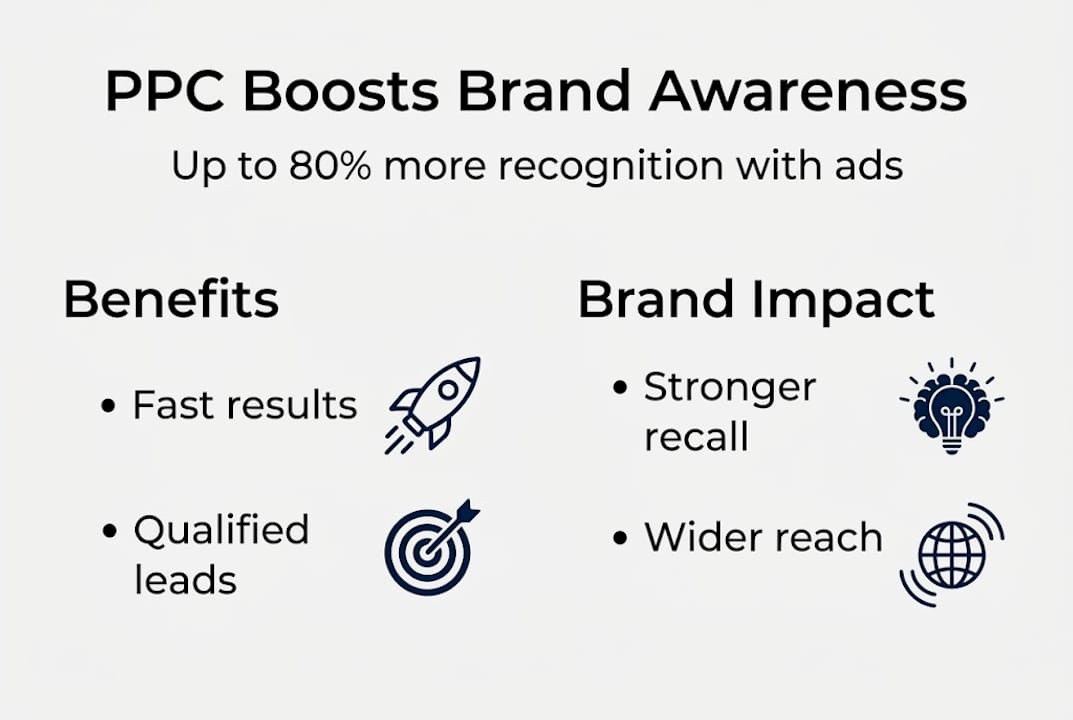
Studies show that PPC can increase brand awareness by up to 80%, even among users who do not click the ad. That visibility alone has real value for local recognition.
You can explore the full range of paid advertising basics to understand which platforms and formats fit your business type.
Pro Tip: Use geo-targeting to limit your ads to your actual service area. Paying for clicks from people 40 miles outside your delivery zone is pure waste. Tighten your radius and watch your cost per lead drop.
How PPC drives immediate traffic and qualified leads
Getting a lead from a PPC campaign is not magic. It follows a clear, trackable sequence that you can optimize at every step. Here is how the process works from start to finish:
- You create an ad with a headline, description, and a link to a specific landing page.
- A user searches for a keyword that matches your targeting settings.
- Your ad appears at the top of Google or within a social feed.
- The user clicks and lands on your page.
- They take action, whether that means calling, filling out a form, or making a purchase.
- You track the result and know exactly which ad produced that lead.
The key word in step six is track. PPC is one of the few marketing channels where you can tie every dollar spent to a specific outcome. That accountability is why serious local businesses rely on it.
PPC is the fastest way to appear in front of customers actively searching for your services. When someone searches “HVAC repair Anaheim” and your ad shows up first, you are not interrupting them. You are answering a need they already have.

Here is a quick breakdown of the core metrics you will track in any PPC campaign:
| Metric | What it measures | Why it matters |
|---|---|---|
| Clicks | Number of times your ad was clicked | Shows how compelling your ad is |
| Cost per click (CPC) | Average cost for each click | Helps manage budget efficiency |
| Conversion rate | Percentage of clicks that become leads | Measures landing page effectiveness |
| Cost per lead (CPL) | Total spend divided by leads generated | The real measure of campaign ROI |
| Impression share | How often your ad shows vs. how often it could | Reveals missed visibility opportunities |
You can review your PPC campaign options to find the right structure for your goals, whether that is driving phone calls, form fills, or in-store visits.
Building strong local lead strategies alongside your PPC campaigns ensures you are not just getting clicks but converting them into paying customers.
Pro Tip: Set up call tracking from day one. Assign a unique phone number to each ad campaign so you know exactly which ad drove each call. Without this, you are flying blind on half your leads.
PPC vs SEO: Understanding when speed or sustainability matters
PPC and SEO are often framed as rivals. They are not. They solve different problems, and the smartest local businesses use both.
Here is a direct comparison to help you decide where to focus your energy and budget:
| Factor | PPC | SEO |
|---|---|---|
| Speed to results | Days | Months |
| Cost model | Pay per click | Time and content investment |
| Sustainability | Stops when budget stops | Builds over time |
| Targeting precision | Very high | Moderate |
| Testing capability | Immediate feedback | Slow feedback loop |
PPC wins when you need speed. Launching a new service? Running a summer promotion? Testing whether a new market is worth pursuing? PPC gives you answers fast. SEO services win when you want to build lasting authority and reduce your dependence on paid spend over time.
Here are the scenarios where PPC is clearly the right tool:
- Seasonal promotions that have a hard start and end date
- New product or service launches where you need immediate visibility
- Competitive markets where organic rankings take too long to build
- Keyword testing before investing in long-term SEO content
- Event-based campaigns tied to local happenings or holidays
“A hybrid approach uses PPC to test keywords for SEO and balances quick results with long-term growth.” This is not just theory. We see it work consistently for local businesses that run PPC campaigns and then use the winning keywords to inform their SEO content calendar.
Using AI-powered insights can make this hybrid strategy even more effective by identifying patterns in your campaign data that human analysis might miss. The combination of paid speed and organic sustainability is a competitive advantage that most local businesses in Southern California have not fully tapped yet.
Overcoming common myths and maximizing PPC ROI
Let’s address the objections that keep local business owners from getting real value out of PPC.
Myth 1: PPC is too expensive for small businesses. This one is simply false. You control your daily budget completely. A well-targeted $300 per month campaign in a local market can outperform a poorly managed $3,000 campaign. The cost is not the problem. The strategy is.
Myth 2: Nobody clicks on ads. Data consistently shows that paid search ads receive a significant share of clicks, especially for high-intent searches like “emergency electrician” or “dentist accepting new patients.” Users searching with urgency click ads at high rates because ads appear first and answer their need directly.
Myth 3: You cannot track PPC results. This is the opposite of reality. PPC is one of the most trackable channels in all of marketing. You know your spend, your clicks, your conversions, and your cost per lead down to the dollar.
Some see ongoing costs and ad blindness as PPC downsides, but a strategic approach maximizes benefits and turns those concerns into manageable variables.
Here are practical actions that improve ROI on any PPC campaign:
- Use negative keywords to block irrelevant searches and stop wasting budget on the wrong audience.
- Split-test your ad copy by running two versions simultaneously to find which headline drives more clicks.
- Optimize your landing page so it matches the promise of the ad. Mismatched pages kill conversions.
- Review your search terms report weekly to find new negative keywords and new keyword opportunities.
- Adjust bids by device since mobile and desktop users often convert at very different rates.
Exploring proven advertising strategies and reviewing a solid digital advertising guide can sharpen your execution significantly.
Pro Tip: Regularly monitor and adjust your bids. Letting campaigns run on autopilot for weeks is how budgets get wasted. A 30-minute weekly review can cut wasted spend by 20% or more.
A smarter mindset: What most local businesses get wrong about PPC
Here is the uncomfortable truth about PPC in competitive local markets: most business owners treat it like a vending machine. Put money in, get leads out. When it does not work immediately, they quit.
The businesses that actually win with PPC treat it like a research lab. Every campaign teaches you something. Which keywords attract buyers versus tire-kickers. Which offer converts better. Which time of day your audience is most ready to act. That information is worth more than any single lead.
Conventional wisdom says to “just try PPC” with a small budget and see what happens. But without a testing mindset, a small budget just produces small, inconclusive results. The real differentiator is not how much you spend. It is how quickly you learn and apply those lessons across your entire marketing strategy.
Understanding PPC for business owners at a strategic level, not just a tactical one, is what separates businesses that grow from those that stay stuck. Rethink PPC as market intelligence, and you will get far more value from every dollar you invest.
Ready to grow? PPC experts can help
If you are a Southern California business owner ready to stop guessing and start growing, PPC is one of the most accessible and effective tools available to you right now. The targeting, the speed, and the measurability make it ideal for local markets where every lead counts.
At Virality Creative, our PPC advertising experts build and manage campaigns specifically designed for local businesses in Southern California. We also offer marketing consulting to help you fit PPC into a broader growth strategy that includes SEO, content, and AI-powered tools. If you want to understand the full picture before committing, learn about PPC and see how it applies to your specific business type and goals.
Frequently asked questions
Can PPC advertising really increase sales for my local business?
Yes. PPC places your business directly in front of customers who are actively searching for your services, which drives qualified traffic that converts into real sales at a measurable rate.
How should I budget for PPC campaigns?
Start with a modest daily budget, monitor your cost per lead, and scale up spending on the ads and keywords that generate results. Effective targeting ensures your budget works harder, even when it is small.
Should I combine PPC with SEO or choose just one?
Combining both gives you the best of speed and sustainability. A hybrid approach lets you use PPC data to identify which keywords are worth building long-term SEO content around.
How long does it take to see results from PPC?
You can see traffic and leads almost immediately after launching. Unlike SEO, PPC delivers speed from day one, though optimizing for the best cost per lead typically takes a few weeks of data.


