

TL;DR:
- Proper foundation including clear goals, a strong landing page, creative assets, tracking, and customer data is essential before advertising.
- Using AI tools for bidding, creative optimization, and audience targeting boosts campaign efficiency and results.
- Continuous measurement, troubleshooting, and creative testing are key to maximizing ROI in local Southern California SMB advertising.
Running paid ads and watching your budget disappear with nothing to show for it is one of the most frustrating experiences a small business owner can face. You’re not alone. Many Southern California SMBs pour money into campaigns that never convert because they skip the foundational steps or rely too heavily on automation without the right setup. The good news is that paid advertising, when structured correctly and paired with AI tools, can become your most reliable source of new leads. This guide walks you through everything from pre-launch preparation to AI-powered optimization, so every dollar you spend works harder for your business.
Table of Contents
- What you need before launching paid ads
- Step-by-step: Setting up your first campaign
- Using AI to optimize campaigns
- Measuring results and troubleshooting issues
- A local marketing expert’s take: What most guides miss
- Ready to get expert help with paid ads?
- Frequently asked questions
Key Takeaways
| Point | Details |
|---|---|
| Strong foundation | Clear goals and quality creative are required before launching paid ads. |
| Platform differences | Facebook is cheaper per lead, Google yields higher intent, so choose based on your business goals. |
| AI integration | Combining AI tools with human oversight can maximize advertising results for SMBs. |
| Continuous improvement | Routine measurement and hands-on adjustments are critical for lasting paid ad success. |
What you need before launching paid ads
Before you spend a single dollar on ads, you need to get your house in order. Skipping this step is the number one reason campaigns fail. Think of it like building a house: no foundation, no structure.
Here’s what you need in place before launch:
- Clear business goals: Are you chasing phone calls, form fills, store visits, or online sales? Each goal shapes a completely different campaign.
- A strong landing page: Your ad is only as good as the page it sends people to. Slow load times, confusing layouts, and weak calls to action kill conversions before they happen.
- Creative assets: You need ad copy, images, and ideally short videos ready to go. Campaigns without visual variety burn out fast.
- Conversion tracking: Install your Meta Pixel and Google Tag before launch. Without tracking, you’re flying blind.
- Customer profile data: Know who your best customers are, where they live, what problems they have, and what makes them buy.
Budget is also a real consideration. Most platforms require a minimum spend to generate enough data for optimization. A realistic starting point for Meta Ads is $300 to $1,500 per month, and Google Ads often requires more to compete in local Southern California markets.
| Requirement | Why it matters | What happens without it |
|---|---|---|
| Landing page | Converts clicks to leads | High bounce rate, wasted spend |
| Tracking pixels | Measures ROI | No data to optimize |
| Creative assets | Captures attention | Low click-through rates |
| Customer profile | Targets right people | Broad, expensive audiences |
| Clear goal | Guides campaign structure | Misaligned objectives |
One thing many guides skip: AI needs a strong foundation to amplify results, and manual setup is sometimes superior to jumping straight into automation. If your data is thin or your landing page is weak, no algorithm will save you.
Pro Tip: Before touching any ad platform, review the paid advertising basics and audit your website for speed and mobile usability. These two steps alone can double your conversion rate once ads go live.
For a broader view of where paid ads fit into your overall strategy, exploring top online ad strategies will help you prioritize channels based on your specific market.
Step-by-step: Setting up your first campaign
With the necessary groundwork in place, here’s how to build your campaign from the ground up.
- Define your campaign goal: Choose one objective per campaign. Lead generation, traffic, and conversions are the most common for local SMBs. Mixing goals in one campaign confuses the algorithm.
- Build your audience: On Meta, start with a detailed interest-based audience, then layer in geographic targeting for your Southern California service area. On Google, focus on high-intent keywords that signal buying readiness.
- Select your creative format: Reels and Stories outperform static images on Meta right now. On Google, responsive search ads give the algorithm room to test headline combinations automatically.
- Set your budget and bidding strategy: Start with a daily budget that allows at least 50 conversions per month for Smart Bidding to work effectively. Below that threshold, manual bidding often performs better.
- Launch and monitor closely: The first 72 hours are critical. Watch for delivery issues, unusual CPMs, or zero conversions. Don’t make major changes immediately, but flag anything that looks off.
Platform differences matter more than most guides admit. Test 15 to 20 creatives per month on Facebook, prioritize Reels and Stories, and use traffic or lead objectives to start. Google rewards relevance, so tight keyword groups and matching ad copy win.
| Feature | Meta (Facebook/Instagram) | Google Ads |
|---|---|---|
| Primary objective | Awareness, leads, traffic | High-intent search, conversions |
| Avg. cost per lead | Lower ($20–$40 range) | Higher ($50–$100+ range) |
| Best creative format | Reels, Stories, carousels | Responsive search ads, display |
| AI automation feature | Advantage+ campaigns | Smart Bidding, Performance Max |
| Audience targeting | Interest and behavior-based | Keyword and intent-based |
Pro Tip: Don’t launch on both platforms simultaneously if you’re new to paid ads. Master one channel first. Meta is generally easier to start with for local service businesses because the audience targeting is more intuitive.
For a more detailed walkthrough of each platform setup, the detailed digital ad setup guide covers every field and setting you’ll encounter. If you want to sharpen your Google Ads approach specifically, these PPC campaign tips break down the nuances of local intent targeting.
Using AI to optimize campaigns
With a campaign live, the next frontier is using AI to maximize every dollar.
AI tools built into ad platforms are genuinely powerful, but they’re often misunderstood. Here’s where they actually help:
- Smart Bidding: Google’s Smart Bidding adjusts your bids in real time based on hundreds of signals, including device, location, time of day, and user behavior. It outperforms manual bidding once you have enough conversion data.
- Dynamic creative optimization: Meta’s Advantage+ automatically tests combinations of headlines, images, and copy to find what resonates. This is especially useful when you have multiple creative assets ready.
- Automated reporting and auditing: Tools like Google’s Performance Insights and third-party platforms flag underperforming ad sets, budget inefficiencies, and audience fatigue before they drain your budget.
- Lookalike and predictive audiences: AI can identify new potential customers who share behaviors with your best existing ones, expanding reach without sacrificing relevance.
Key insight: Hybrid human-AI systems outperform pure automation because AI amplifies results but needs a data and strategy foundation that only experienced marketers can build.
A real example that illustrates this: Facebook campaigns for local service businesses in Southern California often produce a cost per lead around $27, while Google campaigns for the same business can run $70 or more. AI helps compress those numbers over time, but the initial campaign structure, creative quality, and audience definition still require human judgment.
The best approach is setting automated rules (pause ads below a certain CTR, scale budgets when CPL drops) while reviewing results weekly with a human eye. Automation handles the repetitive work. You handle the strategy.

For a practical look at which AI tools for SMBs are worth using in 2026, and to understand the broader AI marketing trends shaping local advertising, both resources offer actionable context. You can also explore how AI-powered visibility works across channels beyond just paid ads.
Measuring results and troubleshooting issues
To ensure your investment pays off, you need to measure, learn, and adapt.
The metrics that matter most for local SMBs are clicks, conversions, cost per lead (CPL), and lifetime value (LTV). Most business owners focus too much on CPL and not enough on LTV. A $70 lead that becomes a $5,000 repeat customer is far more valuable than a $20 lead who never comes back.
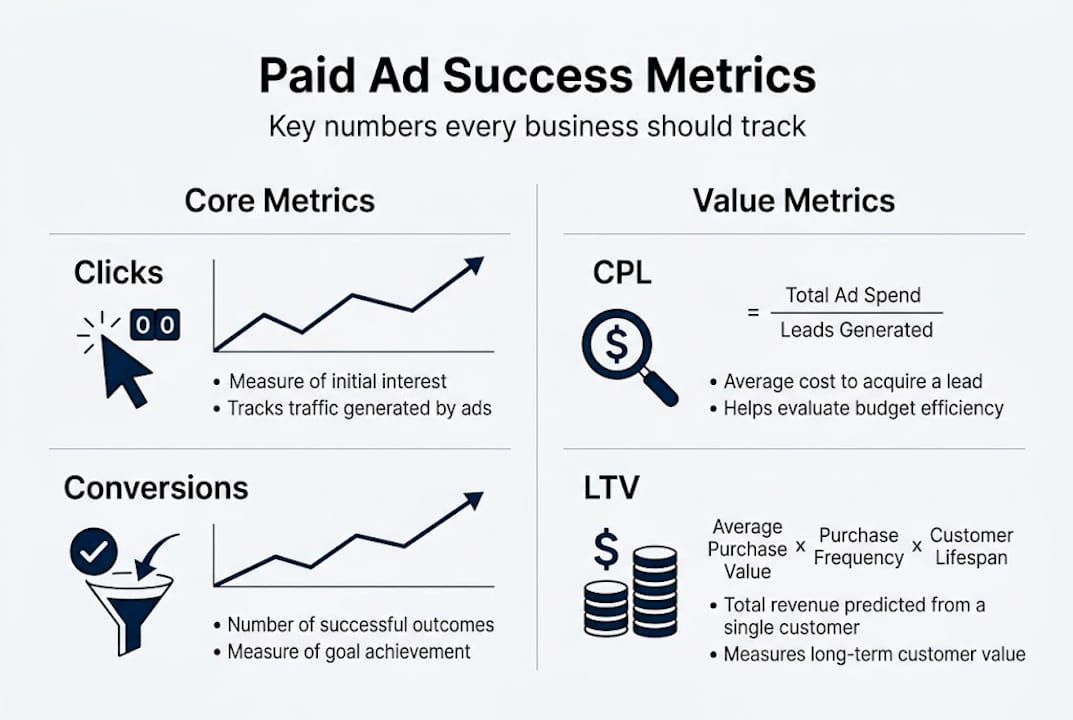
As a guiding principle: monitor LTV, not just CPL to assess true ad effectiveness. This shifts your entire mindset from cutting costs to maximizing quality.
When campaigns underperform, work through this diagnosis:
- Low click-through rate (CTR): Your creative or headline isn’t resonating. Test new images, rewrite your hook, or try a different format.
- High CPL with decent CTR: Traffic is interested but not converting. Audit your landing page for load speed, clarity, and a strong call to action.
- Zero conversions: Check your tracking setup first. A broken pixel is the most common culprit before assuming the campaign itself is the problem.
- Good CPL but low lead quality: Your audience targeting is too broad. Tighten geographic targeting or add negative keywords on Google.
- Results plateau after initial success: Audience fatigue is setting in. Refresh your creative, expand your audience, or test a new offer.
For reporting cadence, keep it consistent:
- Daily: Check for delivery issues, unusual spend spikes, or zero impressions.
- Weekly: Review CPL, CTR, and conversion volume. Make small adjustments.
- Monthly: Evaluate overall ROI, creative performance, and audience health. Plan next month’s tests.
For a deeper look at the PPC performance indicators that matter most, and practical online ad troubleshooting frameworks, both resources will sharpen how you read and respond to campaign data.
A local marketing expert’s take: What most guides miss
Most paid advertising guides treat Southern California the same as every other market. That’s a mistake. Competition here is fierce, consumer expectations are high, and the cost of attention is expensive. Generic advice about “testing your audience” doesn’t cut it when you’re competing against well-funded brands in the same zip code.
What we’ve seen consistently working with local businesses is that the biggest performance gap isn’t budget or platform choice. It’s creative investment. Businesses that test aggressively with fresh, locally relevant visuals and copy outperform those running the same three ads for six months, every single time.
The other thing most guides won’t tell you: automation is a multiplier, not a replacement. If your offer is weak or your landing page is confusing, Advantage+ and Smart Bidding will just spend your money faster. The hybrid approach, where a skilled marketer sets the strategy and AI handles execution, is still the most reliable path to consistent ROI.
Stay proactive. Set a calendar reminder to review campaigns every week. The businesses that win with paid ads treat them like a living system, not a set-it-and-forget-it tool. For a practical look at how this plays out locally, the local lead generation lessons from Southern California campaigns offer real perspective.
Ready to get expert help with paid ads?
If this guide has shown you anything, it’s that effective paid advertising requires the right foundation, consistent creative testing, and a smart blend of human strategy and AI execution. That’s exactly what we do at Virality Creative. Our expert PPC services are built specifically for Southern California businesses that want more leads without wasting budget. We also offer AI campaign optimization to ensure your campaigns get smarter over time, not just bigger. Whether you’re starting from scratch or fixing underperforming campaigns, our local digital marketing team is ready to help you grow with measurable, consistent results.
Frequently asked questions
What’s the minimum budget needed for paid advertising as a small business?
Aim for at least $300 to $1,500 per month per platform to generate enough data for meaningful optimization and creative testing. Going below this threshold often means the algorithm never has enough signal to perform.
Is Facebook or Google Ads better for local leads?
Facebook typically delivers a lower cost per lead but with lower purchase intent, while Google captures users who are actively searching for your service. Your best choice depends on whether you’re building demand or capturing it.
How does AI help with paid advertising?
AI improves results by optimizing bids in real time, automating creative testing, and flagging performance issues early, but it works best after a solid campaign foundation and sufficient conversion data are in place.
What is the most important metric for paid ad success?
The lifetime value of your customers matters more than cost per lead alone. A higher CPL is worth it if those customers generate long-term revenue through repeat purchases or referrals.


