

The digital marketing process provides the structure needed to get you seen and heard among the many competing voices of Southern California’s small to medium-sized businesses. Without a process, all of your marketing efforts will be scattered across various channels and platforms, and you’ll likely end up burning through your budget with no sense of return on investment and little hope of achieving the growth you’re looking for. However, when done correctly, mastering a proven digital marketing process can turn the chaos of your current marketing efforts into a strategic advantage.
This guide is designed to walk you through the steps of preparing for your digital marketing success, executing a successful digital marketing process, common pitfalls to avoid, and measuring and optimizing your digital marketing success. By incorporating AI-based strategies into your digital marketing workflow, you’ll be able to compete successfully in Southern California’s rapidly changing digital marketing landscape and create sustainable growth for your business.
Table of Contents
- Preparing Your SMB for Digital Marketing Success
- Executing the Digital Marketing Process Step-by-Step
- Common Digital Marketing Pitfalls and How to Avoid Them
- Measuring Success and Optimizing Your Digital Marketing
- How Virality Creative Can Help Your SMB Achieve Digital Marketing Success in Southern California
- Frequently Asked Questions Regarding the Digital Marketing Process for SMBs
Key Takeaways
| Point | Details |
|---|---|
| Preparation is Key to Success | Setting clear goals, defining your target audience, and conducting an audit of your digital presence is essential to establishing a solid foundation prior to launching marketing campaigns. |
| Step-by-Step Execution Works | Following a sequential digital marketing process from planning content to implementing AI-based strategies, and ultimately tracking measurable results, is critical to ensuring consistent, measurable progress. |
| Avoid Common Mistakes | Tracking and analyzing metrics, staying focused, and prioritizing local SEO can help prevent wasting budget and maximize the effectiveness of your digital marketing campaigns. |
| Continuously Optimize Matters | Regularly reviewing the performance of your marketing efforts and making data-driven decisions to adjust your marketing to better align with the growth of your business is important. |
Preparing Your SMB for Digital Marketing Success
There are several things you can do to prepare yourself and your business for success in digital marketing. One thing you can do is establish clearly defined business objectives. Are you looking for 30% more qualified leads? A 50% increase in local foot traffic? Or perhaps $100,000 in additional revenue this year? Write down measurable objectives that are directly related to your overall business strategy.
After you have established your objectives, conduct research and develop your ideal customer profile. Who are your customers? What problems are keeping them awake at night? Where are your customers spending their time online? If you operate a business in Southern California, it is also important to understand the demographics of the area you serve as well as the local preferences and regional search habits. For example, the ideal customer profile for a dentist in Pasadena may differ greatly from a plumber in San Diego.
It is also very important to perform a thorough audit of your existing digital presence. Assess the speed, mobile responsiveness, and quality of your website. Evaluate the consistency and level of engagement of your social media profiles. Identify what has been working for you and what has not been generating results. Performing a thorough audit will allow you to identify areas of opportunity.

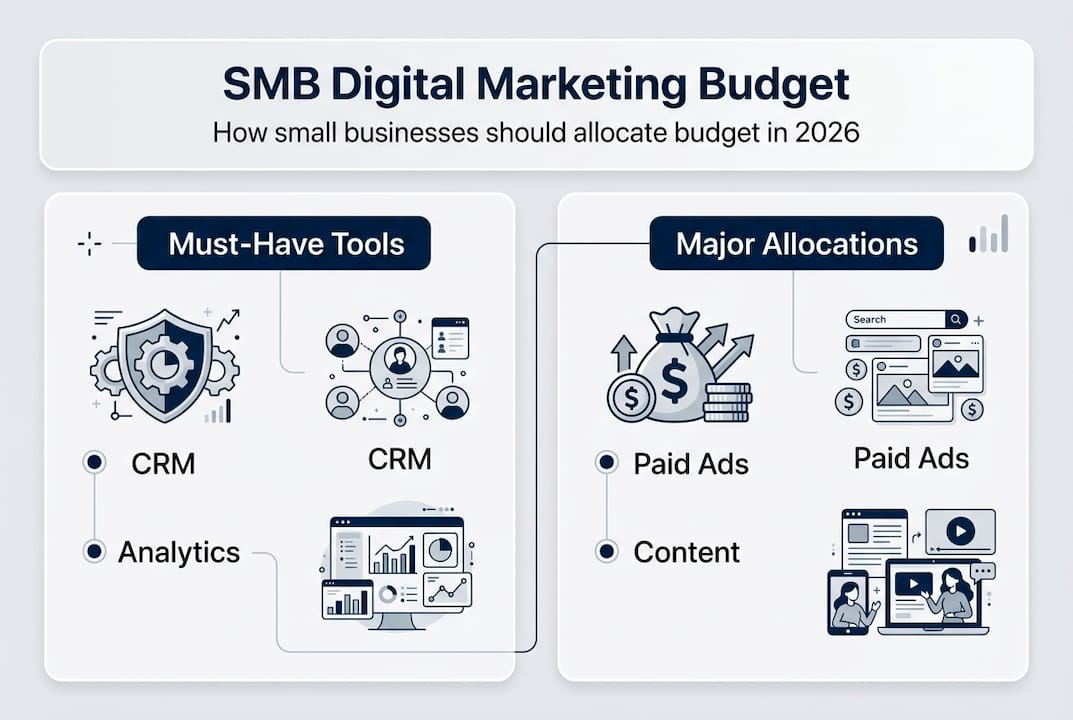
Once you have completed your audit, select your essential marketing tools. While there are many tools available to assist with your digital marketing efforts, you will need a few. These include Google Analytics to track your website traffic and user behavior, a customer relationship management (CRM) system to organize and manage leads, email marketing software to nurture potential customers, and social media scheduling platforms to maintain a consistent social presence. Identifying your target audience and setting clear marketing objectives will result in increased effectiveness of your marketing efforts.
In addition to selecting the right tools, it is also necessary to allocate realistic amounts of funds for your digital marketing efforts. Most SMBs will typically allocate 7-12% of their annual revenue to marketing. Allocate these funds according to the channels where your target audience spends their time online. Reserve 20% of your budget to test new marketing approaches.
Pro Tip: Establish SMART objectives (Specific, Measurable, Achievable, Relevant, Time-bound) to track your progress toward your marketing objectives and adjust your marketing tactics as soon as possible if your results do not meet expectations.
| Required Tool | Purpose | Recommended Tool |
|---|---|---|
| Analytics Platform | Track website traffic and user behavior | Google Analytics, Hotjar |
| CRM System | Manage leads and customer relationships | HubSpot, Salesforce Essentials |
| Email Marketing | Nurture prospects and retain customers | Mailchimp, Constant Contact |
| Social Scheduling | Maintain consistent social presence | Buffer, Hootsuite |
| SEO Tools | Monitor rankings and optimize content | SEMrush, Ahrefs |
At this point, you are prepared to implement campaigns that will generate actual results. Engaging professional digital marketing consulting services can expedite the development of a strong digital marketing foundation.
Executing the Digital Marketing Process Step-by-Step
While execution is what separates successful businesses from unsuccessful businesses, executing a digital marketing process is what separates successful businesses from failing businesses. By following the sequential steps outlined below, you will be able to build momentum in your marketing efforts.
- Create a content marketing plan that includes content that addresses the needs and interests of your local audience. Identify the keywords and phrases your target audience uses in their search queries. Create blog posts, videos, and guides that address the specific needs and questions of your local audience. A Los Angeles restaurant should publish content about dining trends in its neighborhood, not general food-related content.
- Optimize your website for SEO using both on-page and local SEO techniques. Update the title tags, meta descriptions, and header tags of your website to include relevant keywords. Complete and accurately fill out your Google Business Profile. Develop local citations for your business across multiple directories. In 2026, mobile optimization is not optional.
- Launch PPC (pay-per-click) campaigns to generate instant, targeted traffic. Launch your PPC campaigns with Google Ads that target high-intent local searches. Utilize ad extensions to maximize your visibility. Launch with a moderate budget and scale your spending based on what generates conversions.
- Maintain consistent social media presence to build engagement and foster relationships with your local audience. Publish content three to five times per week. Respond to comments within hours. Managing social media is a critical component of fostering relationships with your local audience that lead to sales.
- Implement AI-based technologies that enable personalization, automation, and performance optimization. Implementing AI-based technologies into your marketing workflow enables you to deliver highly personalized experiences to large numbers of customers. Utilize AI to personalize subject lines, ad copy variations, and predictive analytics.
The following types of content are most effective for SMBs:
- Educational blog posts that solve customer problems
- Behind-the-scenes videos that provide insight into your brand’s personality
- Testimonials and case studies that demonstrate social proof
- Targeted ads that promote specific offers or services
- Coverage of local events that helps connect with your local community.
Pro Tip: Utilize AI-based tools to automate repetitive tasks such as scheduling social media content and sending follow-up emails to free up your time for developing marketing strategies and building relationships.
To amplify your visibility and drive traffic to your site, integrate PPC advertising with your organic efforts. When prospects see your brand name listed in both paid and organic search results, it fosters trust and increases the likelihood of conversion. As you combine your organic and paid efforts, the synergistic effect of the combined channels is amplified, and each individual channel performs better.
Common Digital Marketing Pitfalls and How to Avoid Them
Well-intentioned business owners often unknowingly fall into some of the same common pitfalls that others have experienced. Recognizing these pitfalls before you waste thousands of dollars and months of time can save you both.
Not tracking and analyzing key performance metrics results in wasted marketing budget. You cannot improve what you do not measure. Place tracking pixels on your site, create conversion goals, and check your dashboards regularly. Tracking and regularly evaluating your ROI and KPIs will ensure your marketing efforts stay aligned with your business objectives and you remain focused on your objectives.
Attempting to accomplish too much simultaneously diminishes your ability to become proficient in your marketing efforts. Many new business owners launch their marketing efforts on six social media platforms at the same time, and in doing so, spread their resources thin. Select two or three channels where your audience concentrates, master them, and then expand.
Disregarding local SEO severely limits the ability of your SMB to be visible in Southern California. While national SEO strategies may work for larger companies, they do not work for SMBs that serve a specific geographic area. Optimize for “near me” searches, maintain accurate information regarding your locations, and receive reviews consistently. Rankings in the local pack of search results are responsible for driving foot traffic and generating phone calls.
Over-relying on a single marketing channel lessens your business’ ability to adapt and reach your audience. When Facebook changes its algorithm or Google modifies its ranking criteria, businesses that rely on a single source experience a decline in their ability to generate results. Diversify your marketing efforts across organic search, paid ads, social media, and email.
Continuous tracking and optimization of your marketing efforts is vital for long-term growth.
Other mistakes to avoid:
- Failing to account for the fact that 70% of local searches occur on mobile devices.
- Publishing content sporadically and confusing your audience about the reliability of your business.
- Imitating your competitors versus developing your own distinct positioning.
- Conducting inadequate A/B testing and relying on assumption rather than data.
- Failing to update stale content that erodes your credibility.
Pro Tip: Regularly audit your marketing efforts every month and make adjustments to your strategy based on the insights gathered from your data rather than relying on your instincts or industry rumors.
Learn how to avoid these common pitfalls and accelerate your path to profitability by reading the digital advertising guide for 2026.
Measuring Success and Optimizing Your Digital Marketing
Without tracking your digital marketing efforts, you’re essentially operating blindly. Once you begin to track your digital marketing efforts, you’re able to make informed decisions about the direction of your marketing efforts.
Utilize analytics tools such as Google Analytics and platform-specific reporting to evaluate your website traffic, user behavior, and conversion paths. Set up goal tracking to measure the number of forms submitted, phone calls made, purchases made, and other meaningful actions. Review your data on a weekly basis to identify trends early.
Track your ROI by associating conversions and sales with specific marketing channels. Determine your cost per acquisition for each campaign. Compare the customer lifetime value associated with acquiring a customer to the cost of acquiring that customer. If acquiring a customer costs $200 and that customer generates $2,000 in revenue over the course of three years, you’ve identified a winner.
Examine your key performance indicators, which include click-through rates, cost per click, conversion rates, bounce rates, and average session duration. Each indicator provides you with different insights. For instance, high traffic with low conversions indicates that your messaging isn’t aligned. Click-through rates that are low suggest that your ad copy or targeting is weak.
Modify your budgets and marketing tactics based on trends in your data to maximize your growth. Transfer your spending from underperforming channels to channels that are performing well. Run experiments in small batches to validate new approaches before expanding. Data-driven decision-making regarding your ROI and KPIs will drive continuous improvement of your digital marketing campaigns over time.
| Metric | What It Indicates | Target Range for SMBs |
|---|---|---|
| Click-Through Rate | Ad relevance and appeal | 2-5% for search ads |
| Conversion Rate | Landing page effectiveness | 2-10% depending on the industry |
| Cost Per Acquisition | Campaign efficiency | Under 30% of customer value |
| Bounce Rate | Content relevance and UX | Under 50% for key pages |
| Customer Lifetime Value | Long-term business health | 3x+ acquisition cost |
Strategies for optimizing campaigns effectively:
- Continuously test A/B variations on headline, image and call-to-action for campaigns
- Segment your audience by behavior and demographics to create customized messages
- Replace ad creative every 4-6 weeks to reduce user fatigue
- Monitor competitor positions to establish a differentiated value proposition
- Track and document successful tactics in a playbook for future use and replication.
Digital Marketing Consulting Services using Proven Search Engine Optimization Frameworks, provides instant optimization with digital marketing tracking methods. Growing Small Businesses (SMB’s) separate themselves from stagnant ones using these digital marketing tracking methods.
Virality Creative, Digital Marketing in Southern California:
Most Small Business Owners do not have the time to develop their own digital marketing skills. They have too many responsibilities including operating their business, employee management, customer service, and operational duties. Virality Creative assists Southern California businesses such as your own in achieving measurable growth, and eliminating the need to learn a new skill.
Our Digital Marketing Consultants will work closely with you to develop a customized digital marketing strategy that meets your goals and establishes your brand within your competitive marketplace. We do not believe in generic approaches. Each strategy will be developed to address your unique competitive environment, customer segment, and desired growth objectives.
Using artificial intelligence (AI), we enhance digital marketing effectiveness and accuracy by providing targeted and personalized experiences that convert browser traffic to buyer conversions. Our AI implementation extends beyond basic automation to include predictive analytics and dynamic content adaptation.
With extensive experience in developing marketing strategies for Southern California businesses, we possess an understanding of the regional consumer preferences, neighborhood characteristics, and cultural nuances that contribute to successful campaigns that resonate with consumers.
Work with professionals that understand your unique Small Business (SMB) challenges.
The core services provided by Virality Creative include:
- Search Engine Optimization (SEO) to provide your business with local dominance
- Pay-Per-Click (PPC) Advertising to deliver qualified leads immediately
- Social Media Management to build an engaged community
- AI Implementation to automate and enhance the performance of all campaigns
- Web Design to create a digital experience that converts.
Learn how our full range of Digital Marketing Services for Southern California in 2026 can transform your business model.
Common Questions Regarding Digital Marketing Process for SMBs
What is the first step to begin digital marketing for my SMB?
You must first define your business objectives clearly, and define your ideal customer profile. Additionally, audit your current digital assets to determine where you currently stand. By establishing this foundation, each subsequent tactic will be focused on driving growth towards your defined objectives instead of being scatter shot.
In what ways can AI enhance my digital marketing campaigns?
AI identifies patterns in large data sets that humans may overlook, which enables the development of hyper-personalized messaging and predictive targeting. In addition, AI can automate time consuming and repetitive activities, such as sending automated follow-up emails and adjusting ad settings, which frees up your time for strategy. Through its ability to continually learn, AI also optimizes digital marketing campaigns at an efficiency gain rate of 30-50%, while improving conversion rates.
Which digital marketing channels are most beneficial for local Southern California businesses?
Local consumers find businesses primarily through Google Search and Google Maps, which means that Search Engine Optimization (SEO) and Google Business Profile Optimization are essential. However, developing a social media presence on platforms such as Instagram and Facebook creates an engaged community. The best combination of digital marketing channels will depend upon your target audience; however, most small businesses find success with a combination of organic search, paid advertising, and consistent social media presence.
How frequently should I evaluate my marketing campaign performance?
Evaluate your campaign’s performance weekly to recognize and respond to any issues promptly and capitalize on potential opportunities. Conduct a deeper evaluation of your campaign’s performance on a monthly basis to examine trends, Return On Investment (ROI), and the alignment of your strategy. Evaluate your overall strategy quarterly and make major adjustments to your budget and/or marketing channels based on the cumulative data collected.
Will hiring a professional digital marketing consultant benefit a small business?
Hiring a professional digital marketing consultant allows you to accelerate your results by utilizing proven frameworks and avoiding costly mistakes. Trial and Error, lost Ad Spend, and Opportunity Cost associated with delayed growth far exceed the costs of professional digital marketing consulting. Most small businesses achieve a Positive ROI within 90-120 Days when they work with experienced consultants that know the local markets.


