

Many Southern California business owners worry AI marketing is too complex or expensive for their operations. The reality is simpler: AI marketing automation delivers 200-450% ROI for small and medium businesses while cutting campaign launch times by 75%. This guide shows you exactly how to leverage practical AI trends to enhance your local visibility and competitive edge without overwhelming your team or budget. You’ll discover which AI tools matter most, how to measure real results, and a phased approach to implementation that minimizes risk while maximizing returns.
Table of Contents
- Key takeaways
- Understanding key AI trends shaping local digital marketing
- Measuring AI’s impact: return on investment and campaign performance
- Implementing AI in your marketing: a phased, low-risk approach
- Navigating the opportunities and challenges of AI adoption in digital marketing
- Expand your digital marketing with expert AI consulting
- Frequently asked questions
Key Takeaways
| Point | Details |
|---|---|
| Strong ROI potential | AI marketing automation delivers 200 to 450 percent ROI for SMBs and reduces campaign launch times by 75 percent. |
| Hyper local personalization | Use ZIP code data and local cues to tailor messages for neighborhoods. |
| Short form video | Leverage short form video on TikTok and Instagram Reels to boost local discovery and engagement. |
| Human oversight required | Start with low risk AI tools and maintain human oversight throughout rollout to address governance concerns. |
| Phased rollout | Adopt a phased implementation that gradually expands scope while monitoring results and adjusting strategy. |
Understanding key AI trends shaping local digital marketing
The digital marketing landscape for Southern California businesses is transforming rapidly through AI-powered personalization and video content. Mobile accounts for over 60% of local searches, making location-based targeting more critical than ever. Your customers expect marketing messages that speak directly to their neighborhood needs and preferences.
Hyper-local AI personalization uses ZIP code detection and behavioral data to tailor every marketing touchpoint. When someone in Pasadena searches for your services, AI can automatically adjust your messaging to reference local landmarks, community events, or regional preferences. This level of specificity creates immediate relevance that generic campaigns simply cannot match.
Short-form video content on TikTok and Instagram Reels has become the primary discovery channel for local businesses. These platforms prioritize content with local tags and geolocation data, giving your business organic reach within your service area. A 30-second video showcasing your storefront or team can generate more qualified leads than traditional display ads at a fraction of the cost.
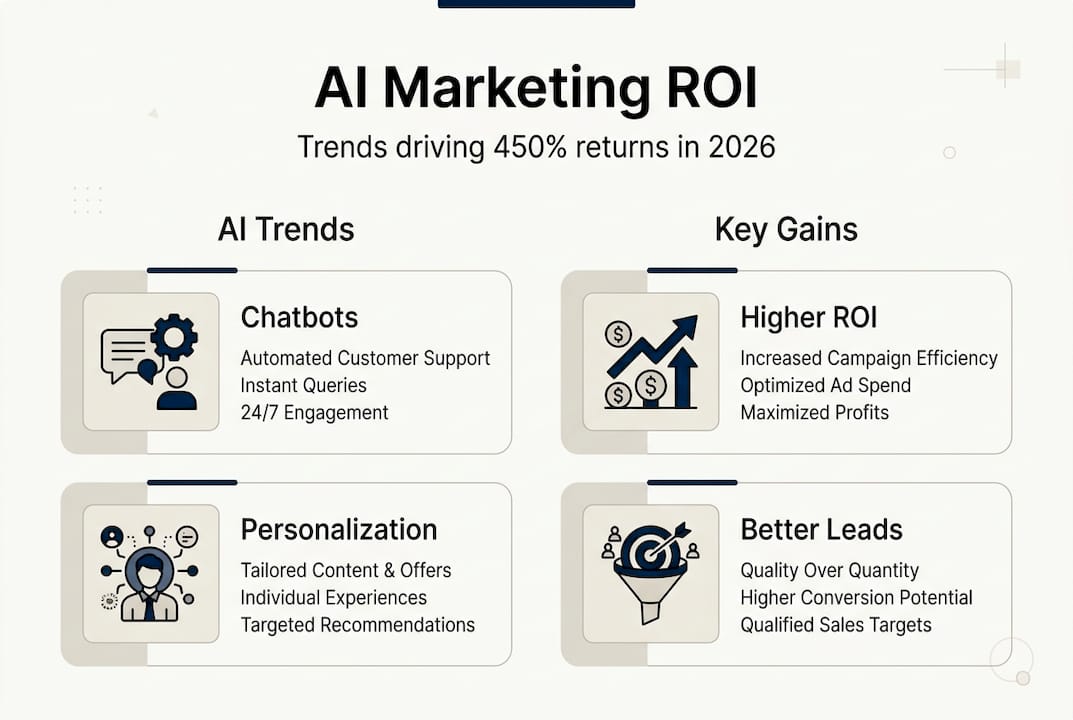
Chatbots powered by natural language processing handle initial customer inquiries 24/7, qualifying leads and scheduling appointments while you focus on service delivery. These AI assistants learn from every interaction, improving response accuracy and customer satisfaction over time. They also capture valuable data about common questions and pain points that inform your broader marketing strategy.
Micro-influencers with authentic local followings amplify your community presence more effectively than celebrity endorsements. AI tools identify influencers whose audience demographics match your ideal customer profile, then track engagement metrics to optimize partnership ROI. This approach builds genuine community connections rather than broadcasting generic messages.
Key AI marketing trends for local SMBs:
- ZIP code-based personalization tailors messages to neighborhood preferences
- Short-form video content dominates mobile discovery on TikTok and Reels
- AI chatbots qualify leads and handle initial customer inquiries automatically
- Micro-influencer partnerships create authentic community engagement
- Location-targeted strategies capture mobile search traffic effectively
Working with a Southern California digital marketing agency that understands these regional dynamics helps you implement AI tools that actually drive foot traffic and phone calls. The technology exists to transform your local visibility, but strategic application makes the difference between wasted budget and measurable growth.
Measuring AI’s impact: return on investment and campaign performance
The financial case for AI marketing is compelling when you examine actual performance data. AI marketing automation delivers 200-450% ROI for small and medium businesses, with campaign execution times dropping by 75% compared to traditional methods. These aren’t projections or best-case scenarios but measured outcomes from businesses similar to yours.
Automation eliminates repetitive tasks like audience segmentation, ad placement optimization, and performance reporting. Your team spends less time on manual data entry and more time developing creative strategies that differentiate your brand. This shift from tactical execution to strategic thinking compounds your competitive advantage over time.
Click-through rates improve by 47% on average when campaigns incorporate AI-driven personalization and timing optimization. The technology analyzes thousands of data points to determine exactly when your ideal customer is most receptive to your message. It adjusts bid strategies in real-time based on conversion probability rather than relying on static rules you set months ago.
The table below compares typical performance metrics between AI-enhanced and traditional marketing approaches for local businesses:
| Metric | Traditional marketing | AI-enhanced marketing | Improvement |
|---|---|---|---|
| Average ROI | 100-150% | 200-450% | 2-3x increase |
| Campaign launch time | 4-6 weeks | 1-1.5 weeks | 75% faster |
| Click-through rate | 2.5-3.5% | 4.5-5.5% | 47% higher |
| Lead qualification accuracy | 60-70% | 85-95% | 25-35% improvement |
| Cost per acquisition | Baseline | 30-40% lower | Significant savings |
These improvements compound over time as AI systems learn from your specific customer interactions and market conditions. A campaign that delivers 250% ROI in month three might reach 350% by month six as the algorithms refine targeting and messaging. Patient implementation paired with consistent measurement yields exponential rather than linear gains.
Start by establishing clear baseline metrics before implementing any AI tools. Track cost per lead, conversion rates, and customer acquisition costs using your current methods. This data provides the comparison point you need to demonstrate AI’s actual impact to stakeholders and justify continued investment.
Pro Tip: Focus on one or two KPIs initially rather than tracking everything. Master AI optimization for lead generation or customer retention first, then expand to additional metrics once you’ve proven the approach works for your business.
A comprehensive digital advertising guide for small businesses helps you identify which metrics matter most for your specific industry and growth stage. Not every AI application delivers equal value, so strategic prioritization ensures you invest resources where they’ll generate the highest returns.
Implementing AI in your marketing: a phased, low-risk approach
Successful AI adoption follows a deliberate progression that builds confidence and capability without overwhelming your team. Start with low-stakes AI like content drafting and lead response, using phased rollout and clear ROI KPIs to guide expansion. This cautious approach addresses the governance and liability concerns that slow adoption at larger organizations while giving you competitive advantages they’re missing.

Begin with AI applications that pose minimal risk to customer relationships or brand reputation. Content drafting tools help create blog posts, social media captions, and email newsletters faster while maintaining your voice. Automated lead response systems acknowledge inquiries instantly and route them to the appropriate team member. These foundational uses deliver immediate time savings without requiring complex integration or oversight.
Phase your rollout over approximately six months to monitor impact and make adjustments:
- Months 1-2: Implement AI content drafting and automated lead acknowledgment, establishing baseline performance metrics
- Months 3-4: Add predictive analytics for audience segmentation and campaign timing optimization based on initial results
- Months 5-6: Expand to dynamic ad creative testing and personalization once you’ve validated the approach with simpler applications
- Ongoing: Continuously refine AI parameters based on performance data while exploring additional use cases that support growth goals
Define specific KPIs before launching each phase so you can objectively measure whether AI delivers the promised benefits. Track metrics like time saved on content creation, lead response speed, conversion rate changes, and cost per acquisition. Document these measurements in a simple spreadsheet that stakeholders can review monthly.
Maintain human oversight throughout implementation to ensure AI outputs align with your brand voice and quality standards. Review AI-generated content before publication, monitor chatbot conversations for accuracy, and audit targeting parameters regularly. This supervision catches errors before they reach customers while building your team’s confidence in AI reliability.
Your governance framework should address data privacy, customer consent, and decision-making authority. Establish clear policies about what AI can decide autonomously versus what requires human approval. Document these guidelines so everyone on your team understands boundaries and escalation procedures.
Pro Tip: Assign one team member as your AI champion who owns implementation, monitors performance, and advocates for resources. This focused ownership prevents AI initiatives from becoming everyone’s responsibility and therefore no one’s priority.
Professional AI implementation support accelerates your learning curve by applying proven frameworks to your specific business context. Expert guidance helps you avoid common pitfalls like over-automation or inadequate testing that undermine results and team confidence.
Navigating the opportunities and challenges of AI adoption in digital marketing
The marketing community holds divergent views on AI’s transformative potential, with optimists noting 3-4x ROI gains while skeptics highlight slow adoption due to governance and strategic concerns. Understanding both perspectives helps you set realistic expectations and prepare for actual implementation challenges.
Optimistic marketers emphasize AI’s ability to amplify human creativity rather than replace it. They point to productivity gains that free teams from repetitive tasks, allowing more time for strategic thinking and relationship building. Revenue growth accelerates when AI handles optimization and testing at scale while humans focus on brand positioning and customer experience design.
Cautious adopters raise legitimate concerns about liability when AI makes autonomous decisions that affect customer relationships or regulatory compliance. They question whether current AI systems truly understand brand nuance and strategic context, or simply pattern-match based on historical data. These skeptics worry that over-reliance on automation erodes the human judgment that differentiates great marketing from adequate campaigns.
The table below contrasts these perspectives on key adoption factors:
| Factor | Optimistic view | Skeptical view |
|---|---|---|
| ROI potential | 3-4x improvement in 6-12 months | Modest gains require 18+ months |
| Implementation risk | Low with proper testing protocols | High due to governance complexity |
| Strategic value | Amplifies human creativity significantly | Limited to tactical optimization |
| Adoption timeline | Immediate competitive advantage | Gradual integration over years |
| Required oversight | Minimal after initial training period | Continuous human review essential |
Reality lies between these extremes. AI delivers substantial benefits when applied to well-defined problems with clear success metrics. It struggles with ambiguous creative challenges that require deep cultural understanding or emotional intelligence. Your success depends on matching AI capabilities to appropriate use cases rather than expecting universal transformation.
Governance frameworks must balance innovation speed with risk management. Establish clear approval processes for customer-facing AI applications while allowing more experimentation with internal tools. Document decision-making criteria so your team understands when to proceed independently versus seeking additional input.
Key considerations for balanced AI adoption:
- Start with internal applications before deploying customer-facing AI
- Maintain human review of all automated customer communications
- Establish clear escalation procedures for AI errors or edge cases
- Document governance policies that address liability and compliance
- Measure both efficiency gains and quality maintenance metrics
Understanding AI governance and oversight challenges helps you build sustainable practices that scale with your business. The goal isn’t perfect AI implementation but rather continuous improvement that compounds competitive advantages over time. Small businesses that start now gain experience and data advantages that larger competitors cannot easily replicate despite greater resources.
Expand your digital marketing with expert AI consulting
Navigating AI marketing trends requires both technical knowledge and strategic insight tailored to Southern California’s competitive landscape. Professional digital marketing consulting helps you identify which AI applications deliver the highest ROI for your specific business model and growth goals. Expert guidance accelerates implementation while avoiding costly missteps that waste budget and undermine team confidence.
Comprehensive AI consulting services provide hands-on support for tool selection, integration, and optimization based on proven frameworks. You gain access to specialists who’ve successfully implemented AI across dozens of local businesses, learning from their experiences rather than making the same mistakes yourself. This expertise is particularly valuable when evaluating vendor claims and determining realistic timelines for measurable results.
Partnering with a team that specializes in digital marketing services for Southern California ensures your AI strategy accounts for regional market dynamics and competitive pressures. Local expertise helps you leverage neighborhood-specific opportunities that national agencies overlook. The combination of AI capability and regional knowledge creates sustainable competitive advantages that compound over time.
Frequently asked questions
What is hyper-local AI personalization and why does it matter for my business?
Hyper-local AI personalization uses ZIP code detection and behavioral data to tailor marketing content for specific neighborhoods and communities. It matters because customers respond more positively to messages that reference their immediate surroundings and local preferences. This targeted approach increases conversion rates while reducing wasted ad spend on audiences outside your service area.
How quickly can I expect to see results after implementing AI in my marketing?
Initial improvements in efficiency and response time often appear within the first month as automation handles routine tasks. Phased AI rollout plans typically span around six months to effectively measure ROI and optimize performance across multiple applications. Full campaign effectiveness improvements become visible after consistent use and refinement based on your specific customer data.
What are the main challenges I might face adopting AI marketing tools?
Challenges include governance, liability, and need for human judgment alongside AI automation. Complex oversight requirements can slow implementation if you lack clear policies and approval processes. Starting with low-risk applications and monitoring KPIs carefully helps you build confidence while mitigating potential problems. Maintaining strategic human oversight ensures quality and compliance throughout your AI journey.
Do I need technical expertise to implement AI marketing tools effectively?
Most modern AI marketing platforms offer user-friendly interfaces designed for marketers rather than developers. You need strategic thinking about which problems to solve and how to measure success more than coding skills. However, partnering with experienced consultants accelerates your learning curve and helps you avoid common implementation pitfalls that waste time and budget.
How do I balance AI automation with maintaining authentic customer relationships?
Use AI to handle repetitive tasks and initial customer touchpoints while reserving complex interactions for human team members. Automated systems should acknowledge inquiries instantly and provide helpful information, then route qualified leads to your team for personalized follow-up. This approach combines AI efficiency with human relationship-building that creates loyal customers and referrals.


