

TL;DR:
- AI enhances content creation by automating structure and volume, reducing production time and costs.
- Human oversight, local knowledge, and quality editing are crucial to avoid pitfalls like inaccuracies and generic tone.
- Successful SMBs leverage AI as a creative amplifier, combining it with expertise for authentic, valuable content.
Over 86% of marketers now use AI in their content processes, yet most small business owners in Southern California still feel stuck between curiosity and confusion. Is AI going to replace your copywriter? Will Google penalize your blog? The short answer to both is no, but the full picture is more nuanced and more useful than that. This guide breaks down exactly what AI content creation is, how it works in practice, what results real businesses are seeing, and how to avoid the pitfalls that trip up teams who rush in without a plan.
Table of Contents
- What is AI content creation?
- How does AI content creation work?
- Benefits and benchmarks for SoCal businesses
- Risks, quality pitfalls, and how to win with AI
- Our take: The real secret to lasting success with AI content
- How we can help your business thrive with AI content
- Frequently asked questions
Key Takeaways
| Point | Details |
|---|---|
| AI boosts marketing output | Using AI helps your business produce more content faster and often at a lower cost. |
| Hybrid approach wins | Combining AI speed with human expertise creates the best content for local visibility. |
| Quality matters most | Editing, fact-checking, and adding local insights are essential for long-term marketing success. |
| Big ROI for small businesses | Case studies show local SMBs can double leads and cut costs by 50x with AI integration. |
What is AI content creation?
With adoption rates skyrocketing across the industry, it makes sense to nail down exactly what AI content creation means before deciding whether it fits your business.
AI content creation uses AI tools as collaborators in planning, researching, writing, editing, and optimizing content. Think of tools like GPT-4 or Claude as a co-writer that never sleeps, never gets writer’s block, and can produce a rough draft in seconds. That does not mean the output is ready to publish. It means your team spends less time staring at a blank page.
Here is what AI can realistically help you produce:
- Blog posts and articles targeted to your local audience
- Social media captions tailored to each platform’s tone
- Email campaigns with personalized subject lines and body copy
- Ad copy for Google and Meta campaigns
- Product and service descriptions optimized for local SEO
The key distinction is this: AI handles structure and volume, while you supply direction and voice. A tool like GPT-4 does not know that your HVAC company serves the Inland Empire, that your customers ask about energy rebates every summer, or that your brand sounds friendly but never pushy. You bring that context. The AI amplifies it.
“AI is not a replacement for human creativity. It is a force multiplier for teams that know what they want to say.”
For SoCal SMBs exploring AI tools for SMB marketing, the starting point is always clarity on your goals. Are you trying to publish more blog content? Respond faster on social media? Write better ad copy? Once you know the goal, picking the right tool becomes much easier. And if you want to understand the bigger picture of AI in local marketing, the opportunity for small teams is genuinely significant.
How does AI content creation work?
Now that you know what AI content creation is, let’s break down how these systems actually work and where your involvement fits in.

Core mechanics include prompt engineering, Retrieval-Augmented Generation (RAG), agentic workflows, and fine-tuning for brand voice. Each plays a different role in the content process.
Prompt engineering is simply the skill of writing clear instructions for an AI tool. The better your prompt, the better your output. Instead of typing “write a blog post about roofing,” you might write: “Write a 600-word blog post for a San Diego roofing company targeting homeowners worried about storm damage. Use a friendly, direct tone. Include a call to action to book a free inspection.”
RAG (Retrieval-Augmented Generation) lets the AI pull from your own data, like your website, FAQs, or service pages, to generate content that actually reflects your business. This reduces generic output and keeps facts accurate.
Agentic workflows automate a chain of steps: research a topic, draft the content, check for SEO keywords, and flag it for human review. You stay in the loop without doing every step manually.
Fine-tuning trains a model on your past content so it learns your brand voice over time.
Here is a simple comparison of traditional versus AI-assisted content workflows:
| Step | Traditional workflow | AI-assisted workflow |
|---|---|---|
| Topic research | 1-2 hours manually | 10-15 minutes with AI |
| First draft | 2-4 hours writing | 5-15 minutes with prompts |
| Editing and review | 1 hour | 30-45 minutes human polish |
| Publishing | Manual scheduling | Automated via tools |
A typical workflow looks like this:
- Brainstorm content ideas with AI based on your target keywords
- Use AI to research competitor gaps and local search trends
- Generate a structured draft using a detailed prompt
- Human editor adds local examples, brand voice, and fact-checks
- Schedule and publish using your content management system
Pro Tip: Always write your prompts as if you are briefing a new employee. Include your audience, tone, goal, and any facts the AI should know. You will get dramatically better results from the first try.
Building hybrid human-AI workflows is the approach that consistently outperforms fully automated pipelines, especially for local businesses where trust and authenticity matter.
Benefits and benchmarks for SoCal businesses
Having seen how it works, let’s look at what these tools can actually accomplish for small businesses right here in Southern California.
The numbers are hard to ignore. One-person teams have published 130 blogs in 26 weeks at a fraction of traditional agency costs, roughly five posts per week with AI doing the heavy lifting on drafts. That kind of output would cost tens of thousands of dollars with a traditional content team.
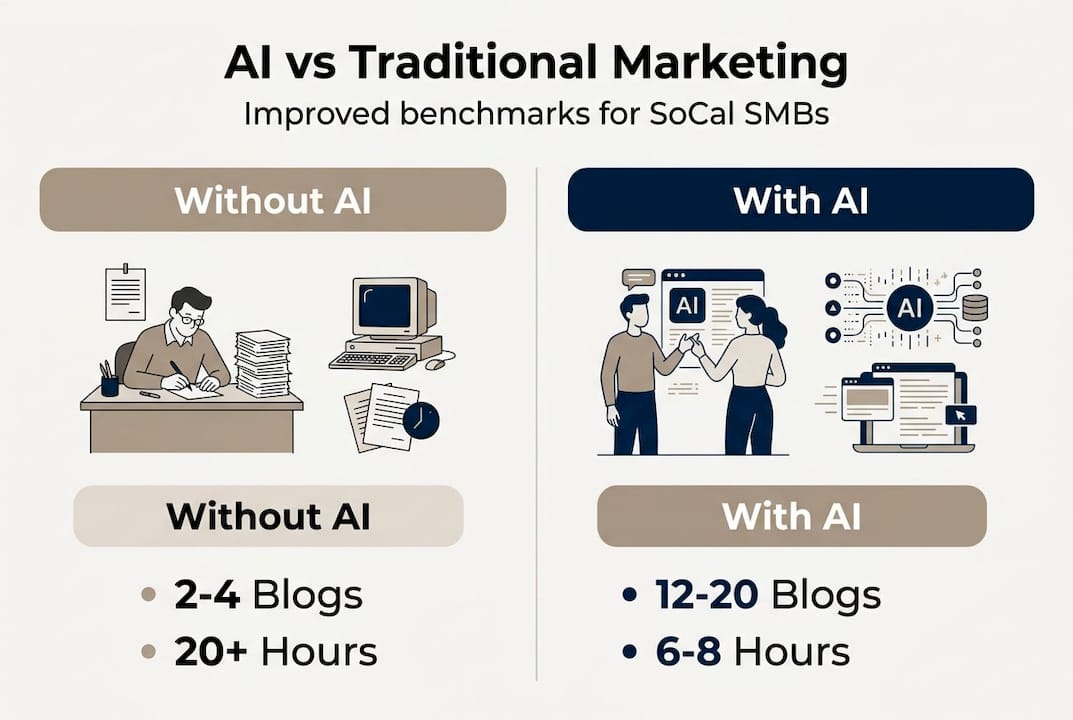
Here is a quick benchmark table for context:
| Metric | Without AI | With AI assistance |
|---|---|---|
| Blog posts per month | 2-4 | 12-20 |
| Hours spent on content | 20-30 hrs/week | 8-12 hrs/week |
| Cost per blog post | $200-$500 | $20-$60 |
| Social posts per week | 3-5 | 10-20 |
Real SoCal results back this up. A med spa doubled inquiries after switching to AI-optimized content. A remodeling firm added 131 qualified leads and built an $800,000 pipeline in just 90 days using AI-driven content and targeted ads.
What makes this possible for small teams:
- Volume at scale: AI lets a two-person marketing team produce content like a department of ten
- Consistent publishing: Algorithms reward regular content; AI makes consistency realistic
- Faster response to trends: You can draft a timely post in hours, not days
- Lower cost per lead: More content means more organic traffic without proportionally higher spend
Tracking your own benchmarks against AI marketing ROI trends helps you set realistic goals and measure whether your investment is paying off. Start with baseline numbers before you begin so you have something to compare.
Risks, quality pitfalls, and how to win with AI
After seeing the huge upside, it is just as important to understand what can go wrong and how to do better than your competitors.
AI is powerful for drafts and research but may struggle with creativity and can produce factual errors unless fact-checked or RAG-enabled. This is not a reason to avoid AI. It is a reason to use it with intention.
The most common pitfalls local businesses run into:
- Hallucinations: AI sometimes invents statistics, names, or citations that sound real but are not. Always verify facts independently.
- Generic tone: Without a strong prompt and human editing, AI output can feel bland and interchangeable with every other business in your category.
- Missing local flavor: AI does not know about the 405 traffic, the summer heat in the Valley, or the specific neighborhoods your customers live in. You have to add that.
- The Mount AI trap: Low-quality unedited content may spike briefly in search rankings then drop sharply. Google’s systems reward genuine helpfulness, not volume alone.
“Google does not penalize AI content as a category. It penalizes content that is unhelpful, low-quality, or clearly produced at scale without human oversight.”
Google’s E-E-A-T framework (Experience, Expertise, Authoritativeness, Trustworthiness) is the standard your content is measured against. AI can help you meet that standard if you layer in real expertise. It will work against you if you skip that step.
Pro Tip: After every AI draft, ask yourself: “Does this say something only my business could say?” If the answer is no, add a local example, a client story, or a specific insight from your experience before publishing.
Building trust with media like photos and video alongside your AI content strategy also signals authenticity to both Google and your customers.
Our take: The real secret to lasting success with AI content
Here is what we have learned helping SoCal businesses stay ahead, and it is not what most marketing blogs will tell you.
The businesses that plateau with AI are the ones treating it like a vending machine. They put in a prompt, take out a blog post, hit publish, and wonder why rankings stall after a few months. The businesses that keep growing are using AI as a creative amplifier, not a hands-off solution.
Speed is real. But speed without substance is just noise. Your competitors can access the same AI tools you can. The differentiator is what you bring to the table: your knowledge of the local market, your customer relationships, your hard-won expertise in your industry. That is what makes content worth reading and worth ranking.
SoCal SMBs have a genuine edge here. Regional specificity, local regulations, neighborhood-level knowledge, and community stories are things no generic AI model can replicate without your input. Lean into that. Use AI tools for SoCal growth as your engine, but keep your hands on the wheel. The businesses winning right now are not the ones publishing the most content. They are publishing the most useful content, and AI is just helping them do it faster.
How we can help your business thrive with AI content
If you want to move from curiosity to action and make AI content work for you, here is how our team can help.
At Virality Creative, we work with SoCal SMBs to build AI content strategies that actually perform, not just produce volume. Our AI optimization services are designed to improve your visibility on Google Search, Google Maps, and AI platforms like ChatGPT. If you want a clearer picture of where your marketing stands and what to prioritize, our consulting for SMB marketing gives you a personalized roadmap. And if you are still building your foundation, start by exploring why AI tools matter for businesses at your stage. We combine local expertise with advanced technology to drive results you can measure.
Frequently asked questions
Does Google penalize AI-generated content?
Google does not penalize AI content as a category, but low-quality or unedited content that lacks real expertise and helpfulness can lose rankings over time. Focus on quality and genuine value, and your content will perform regardless of how it was produced.
How much time can AI content creation save my small business?
AI saves 10-14 hours per week for roughly one in three marketing teams, making it one of the highest-leverage tools available to small businesses with limited staff. Those hours add up fast when you redirect them toward strategy and customer relationships.
What types of content can AI help my business produce?
AI tools assist with planning, writing, and optimizing blogs, social media posts, emails, ad copy, and local SEO content. Basically, if it involves words and a target audience, AI can play a supporting role in creating it.
What are the biggest risks with AI content?
Hallucinations and weak creativity are the two most common failure points, which is why human editing and local expertise are not optional extras but essential parts of any AI content workflow. Treat every AI draft as a starting point, not a finished product.


